Although I was born and raised in the USA, I have been living and working in Sweden of most of the last twenty years. During that time I have seen many changes occur in the world of entertainment and media. I remember when I first got to Sweden there where only two TV channels that usually didn’t show programs more than a few a day. One Friday night, during prime time, I watched a documentary on the mating behaviours of horses. It wasn’t bad but not what you would expect to watch with your friends while drinking beer on a Friday night.
When commercial television was finally allowed in Sweden nobody in the advertising industry knew what to do with it. Swedish advertising and media agencies where all about print! This opened a niche for small specialized consulting companies who could advise customers and their agencies on how to use TV. A buddy of mine was very successful in this business and his main qualifications where that he was very smart and he grew up watching commercial TV in the states. With time the advertising community became savvy to TV but it was amazing how long it took for many agencies to seriously include TV as a real part of the media mix.
Some years later commercial radio started up in Sweden and the same process was repeated. Traditional ad and media agencies had no expertise in radio. Specialized “radio” consultancies thrived for years until the advertising environment had adapted to this new media. (I still think radio is highly misunderstood, poorly used and undervalued in Sweden.)
As the internet entered our lives we have seen the same type of conservative approach from the advertising environment. Most agencies still don’t understand the real value of the internet and have little or no in-house competence. If they do have internet competence they typically treat it as a special channel and it is an exception to see campaigns in which the internet is fully integrated.
Now the mobile telephone is lurking on the horizon as the next great new media environment. The question is how long it will take advertising agencies to embrace the opportunities created by the mobile telephone. The mobile phone makes it possible to present the right message, adapted to the customer's situation (place, time, interests, etc) combined with the perfect payment solution. The mobile phone interacts easily with all other media and can turn static two dimensional media like print and billboards into interactive media. Imagine getting customers to run all over town taking photos of billboards in various locations in order to win a backstage pass or a trip to the Bahamas.
The end result will be more cost effective campaigns that target the right customers with the right info at the right time and place which will both increase customer’s satisfaction with the advertiser (and advertising in general) and increase sales.
Tuesday, November 14, 2006


All in a Day's Work!
The only thing that is worse than throwing your pearls before swine is when the swine reject your pearls!
Monday, November 06, 2006
Unleashing the Power of Mobility!
Everyone knows it is going to happen! Just like at some point everyone knew that the internet was going to fundamentally change the way we work and play! Even during the deepest crash of the internet economy the life of the internet itself was never really in question. The only thing that really crashed about the internet was the business models. Most of us just surfed right through the crash of the internet economy. Some people lost lots of money but most of us just surfed on oblivious to the financial struggles behind the scenes of many internet companies. Many internet sites disappeared but others popped up to replace them and many survived and even thrived.
Now it is happening again! This year the mobile phone celebrates its 50th anniversary. (I am proud to say that my employer played a key role in the creation of the mobile phone). During the past 50 years the mobile phone has revolutionized voice communication as well as the telecom industry. It is fitting then that this youthful 50 year-old stands poised once again to radically change our lifestyle and our industry.
This time the change is taking place in the world of data communication and like before this revolution will have its losers and its heroes. In order to understand the magnitude of this new change you could start by imagining that everything we do on the internet today will be moved into the mobile telephone. That in itself may not seem like such a big deal and in some ways may even be perceived as a weaker version of the internet. After all, who wants to surf the internet on such a little screen and with lower speed than most people have at home or at work. But anyone voicing opinions like this needs to think again!
First of all far from everyone has easy affordable access to the internet. Large parts of the world have little or no access to the internet. The mobile internet will make a powerful contribution to the welfare and quality of life for many people in the world.
In the parts of the world where a large part of the population has easy, affordable access to the internet there are still enormous opportunities that a mobile internet will create. Imagine all the strengths of the internet enhanced by a few key benefits of the mobile phone: Mobility, Positioning, Interactivity and Payment!
Even if the mobile phone can give you internet access where ever you are it is still highly reactive. Users need to go in and search for the pertinent information they are looking for. One advantage of the mobile phone is that it can provide key information to content providers that will help them give users information they want or need before they actually seek it. Drivers can be provided with information about road conditions as they travel down a highway. Spectators can sit in the stadium watching their home team playing football while at the same time viewing highlights on their phones of other matches going on at other places. The alternatives are endless.
Mobile phones can easily turn all kinds of inanimate objects like billboards, beer cans, or newspaper ads into interactive media. Imagine getting customers to run all over town taking pictures with their telephones of the same posters on billboards at various locations in order to win back stage passes or a trip to the Bahamas. Or customers sending in pictures taken with their telephones of a coke can. With today’s picture recognition technology advertisers can cost-effectively identify pictures of one individual poster or coke can without bar codes making it possible to activate brands in exciting new ways.
The mobile phone has the potential to replace the credit card as we know it. The mobile phone could become the primary payment tool in a large part of the world. But if you connect mobile payment together with all the other benefits of mobility, interactivity and positioning, you begin to understand the real power of the mobile phone. The mobile phone makes it easier to target the right customer segments with the right message, to involve the customer in an interactive dialog and finally to execute the transaction.
Imagine the following transaction process:
You receive a video message from your favourite music artist asking if you would like to win tickets to his/her next concert!
Then receiving a free track from the artist’s next album.
Then being offered to purchase the entire album at a special price.
Then being offered free music from similar up and coming artists within the same genre as your favourite artist.
The process can go on for a long time!
Here is another scenario:
Imagine sitting at home watching a James Bond movie on a DVD or via Cable TV. We all know that at some point in time James is going to give the camera a great view of his Omega watch or his SonyEricsson mobile phone. You push a button on your mobile phone and James turns towards you and says “I see you are interested in my watch. This is the new Omega etc, etc, etc! For those of you watching this movie you can get a 10% discount on the watch and it will be delivered to your door tomorrow.” You push another button on your phone and the watch is charged to your telephone bill and you continue watching the movie. The next day you get your watch!
To paraphrase Kotler: Customers who get the right product for the right price, when and where they want it are satisfied! The mobile phone makes this easier than it has ever been!
Now it is happening again! This year the mobile phone celebrates its 50th anniversary. (I am proud to say that my employer played a key role in the creation of the mobile phone). During the past 50 years the mobile phone has revolutionized voice communication as well as the telecom industry. It is fitting then that this youthful 50 year-old stands poised once again to radically change our lifestyle and our industry.
This time the change is taking place in the world of data communication and like before this revolution will have its losers and its heroes. In order to understand the magnitude of this new change you could start by imagining that everything we do on the internet today will be moved into the mobile telephone. That in itself may not seem like such a big deal and in some ways may even be perceived as a weaker version of the internet. After all, who wants to surf the internet on such a little screen and with lower speed than most people have at home or at work. But anyone voicing opinions like this needs to think again!
First of all far from everyone has easy affordable access to the internet. Large parts of the world have little or no access to the internet. The mobile internet will make a powerful contribution to the welfare and quality of life for many people in the world.
In the parts of the world where a large part of the population has easy, affordable access to the internet there are still enormous opportunities that a mobile internet will create. Imagine all the strengths of the internet enhanced by a few key benefits of the mobile phone: Mobility, Positioning, Interactivity and Payment!
Even if the mobile phone can give you internet access where ever you are it is still highly reactive. Users need to go in and search for the pertinent information they are looking for. One advantage of the mobile phone is that it can provide key information to content providers that will help them give users information they want or need before they actually seek it. Drivers can be provided with information about road conditions as they travel down a highway. Spectators can sit in the stadium watching their home team playing football while at the same time viewing highlights on their phones of other matches going on at other places. The alternatives are endless.
Mobile phones can easily turn all kinds of inanimate objects like billboards, beer cans, or newspaper ads into interactive media. Imagine getting customers to run all over town taking pictures with their telephones of the same posters on billboards at various locations in order to win back stage passes or a trip to the Bahamas. Or customers sending in pictures taken with their telephones of a coke can. With today’s picture recognition technology advertisers can cost-effectively identify pictures of one individual poster or coke can without bar codes making it possible to activate brands in exciting new ways.
The mobile phone has the potential to replace the credit card as we know it. The mobile phone could become the primary payment tool in a large part of the world. But if you connect mobile payment together with all the other benefits of mobility, interactivity and positioning, you begin to understand the real power of the mobile phone. The mobile phone makes it easier to target the right customer segments with the right message, to involve the customer in an interactive dialog and finally to execute the transaction.
Imagine the following transaction process:
You receive a video message from your favourite music artist asking if you would like to win tickets to his/her next concert!
Then receiving a free track from the artist’s next album.
Then being offered to purchase the entire album at a special price.
Then being offered free music from similar up and coming artists within the same genre as your favourite artist.
The process can go on for a long time!
Here is another scenario:
Imagine sitting at home watching a James Bond movie on a DVD or via Cable TV. We all know that at some point in time James is going to give the camera a great view of his Omega watch or his SonyEricsson mobile phone. You push a button on your mobile phone and James turns towards you and says “I see you are interested in my watch. This is the new Omega etc, etc, etc! For those of you watching this movie you can get a 10% discount on the watch and it will be delivered to your door tomorrow.” You push another button on your phone and the watch is charged to your telephone bill and you continue watching the movie. The next day you get your watch!
To paraphrase Kotler: Customers who get the right product for the right price, when and where they want it are satisfied! The mobile phone makes this easier than it has ever been!
Tuesday, October 24, 2006
Smarter than an ant and dumber than a pike!
I suppose everyone has heard about the research that was done in which minnows where put into a glass cylinder in an aquarium with a pike and after the pike had bumped his head on the glass cylinder about 7 times he quit trying to eat the minnows. Then when the glass cylinder was removed the pike still would not eat the minnows even if the minnow swam right in front of his face. The pike had learned once and for all that there was no point in trying to eat the minnow. Been there, done that!
There is another story told by a professor (I don’t remember who, sorry!) who said that ant’s have a very low intelligence as individuals but very high intelligence as a group. People on the other hand have high intelligence as individuals and low intelligence as a group. I think anyone who has worked in very large organizations recognizes this problem. I am frequently amazed at what sound views many people in large organizations have about the problems facing their companies and what actions need to be taken to improve the situation. When all of these clever individuals get together the end result often turns out much worse than it would have if just one person had done the thinking.
Considering these two stories I have come to the conclusion that our ambition should be to be at least as smart as ants are when working in groups never losing sight of the groups overriding mission. We should at the same time be relentless in our strivings to excel in fulfilling our mission, continuously re-evaluating the situation and never letting the long shadow of history block our vision of the future.
There is another story told by a professor (I don’t remember who, sorry!) who said that ant’s have a very low intelligence as individuals but very high intelligence as a group. People on the other hand have high intelligence as individuals and low intelligence as a group. I think anyone who has worked in very large organizations recognizes this problem. I am frequently amazed at what sound views many people in large organizations have about the problems facing their companies and what actions need to be taken to improve the situation. When all of these clever individuals get together the end result often turns out much worse than it would have if just one person had done the thinking.
Considering these two stories I have come to the conclusion that our ambition should be to be at least as smart as ants are when working in groups never losing sight of the groups overriding mission. We should at the same time be relentless in our strivings to excel in fulfilling our mission, continuously re-evaluating the situation and never letting the long shadow of history block our vision of the future.
Wednesday, September 20, 2006
Hard Facts, Dangerous Half-Truths & Total Nonsense by Jeffrey Pfeffer and Robert I. Sutton

Some critics have suggested that "Hard Facts" borders on common sense but it is the apparent lack of common sense in business that often amazes and shocks me. In fact, the idea of common sense is exactly the type of the strongly held belief that "Hard Facts" puts into question. As far as I can tell, all people have sense but not much of it is common! There is so much about business management that appears to be obvious to so many when reading business literature or attending conferences and yet when we get back to the office we fall back on old behaviours and entreched belief systems. "Hard Facts" truly gives the hard facts on what is one of the most significant underlying problems with business life today. Business initiatives fail because they are initiated to solve problems that aren’t fully understood and achieve goals that aren’t clearly defined with methodology that at best is ineffective and at worse destructive!
Saturday, September 02, 2006
THE MARKETING PLAN: THE GOOD THE BAD AND THE UGLY
Following is another simple marketing plan template that I have used from time to time in my work. Like my earlier entry "The World's Shortest Marketing Plan" this plan template is very short and should be kept that way!
The Good
Virtually all companies conduct some sort of planning, whether it be it the form of budgets, strategic plans, business plans or marketing plans. Despite the various problems, some of which are described below, many companies have discovered the hidden benefits of planning activities. Here I would like to emphasize the planning activity as opposed to a planning document, tool or method. It is in the activity, the action of planning that the real value is achieved. As Dwight Eisenhower said "Plans are nothing, planning is everything".
Of course the planning activity must be documented in some way, however, a planning document should be living organism, continuously adapting to new situations and new environmental requirements. Like an organism it should be continuously developing and learning. As time goes, the document should reflect the accumulated knowledge and experience of the actors in the business which it represents. Many managers have discovered the value of planning and whether one intends to reveal the "truth" in an official document or not, many valuable "truths" can be discovered during the act of planning. These "truths", in the form of facts, ideas or discoveries of correlations and relationships between variables, are beneficial in the running of the business.
The Bad
Unfortunately, in many companies these planning tools are primarily seen as tedious routines which must be executed in order to satisfy requirements from top management. As soon as these plans are made and presented they are far too often filed away and never to be seen again. They may be brought out again next year to be used as a guide for the new plan.
One of the most common planning tools is the budget. Budgets are manipulated by everyone. Those responsible for creating the budgets build in buffers in order to insure that the budget can be achieved. Those who review and/or approve the budgets of others, fully aware of the manipulations which take place, regard most budgets with suspicion. This results in responses from senior management with arbitrary demands for higher sales, more margin or lower costs by amounts or percentages which, in objective terms, could only be interpreted as incompetence, either on the part of the budget maker or the evaluator. However, since everyone knows the rules, no such conclusions are drawn. In fact, a manager or director who attempts to budget "honestly" may be deemed incompetent since he will undoubtedly be judged according to the same measures as all others who are playing the budget manipulation game.
This manipulation is not limited to budgets. It is prevalent in all kinds of planning activities in many companies and organizations. For this reason one might question the validity of this type of planning tool as some companies have done and eliminated the use of budgets for example.
The Ugly
If these planning methods are not lost deep in a file cabinet and even if they are done with honest assumptions and good analysis they still run a risk of becoming "holy gospel". Many planning tools are mystically transformed from paper documents to stone tablets. These tablets are then followed blindly as a surrogate "Ten Commandments" and no deviations or alterations to the plan are allowed. Alternatively, these tablets are used to bash the heads of managers who have not achieved the goals set forth.
MARKETING PLAN
Depending on ones definition of marketing, the marketing plan could focus on everything from specific sales related activities, to virtually every aspect of the business that affects a company's competitive position in the market. This broader definition could involve relationships with suppliers for components or sub-assembly, financial institutions, production technology or anything else that could affect the strength of the company in the market place.
The following elements should be included in a marketing plan:
I. Facts and Analysis
A. Market size, in volume and value by product group
B. Average price by product and/or product group
C. Distribution channel analysis
1. Key distributors or channels
a. Description of their business or of the channel
b. Sales, and share of market
c. Sales of our products
d. Description of terms of business, (margins, logistics, etc)
D. Competition analysis
1. Brand positioning
2. Market share
3. Relationship to trade
4. Consumer image
5. Strengths and weaknesses
6. Expected reaction to our company or product
E. Our own strengths and weaknesses
1. Brand positioning
2. Market share
3. Relationship to trade
4. Consumer image
5. Strengths and weaknesses
6. Short-term product or market needs
7. Long-term product or market needs
F. Consumer Analysis
1. Buying Behavior
2. Purchase Criteria
3. Lifestyle Analysis (if possible)
II. Plan of Action
A. Define adjustments to strategy (product focus, brand positioning etc)
B. Define tactical actions
1. Attacks to competitors weaknesses
2. Target key competitors
3. Promotional Plan
a. Internal actions ( to promote products within own sales
organization)
b. Trade actions ( to promote products to distribution channels)
c. Consumer actions ( to promote products to Consumers)
d. Estimated costs
III. Financial Plan (targets/expectations for relevant period 1-5 years)
A. Market share
B. Sales targets
C. Selling Expenses
D. Returns (Net Operating Profit)
E. Market Investments
F. Cash Flow Analysis (Net Present Value)
The Good
Virtually all companies conduct some sort of planning, whether it be it the form of budgets, strategic plans, business plans or marketing plans. Despite the various problems, some of which are described below, many companies have discovered the hidden benefits of planning activities. Here I would like to emphasize the planning activity as opposed to a planning document, tool or method. It is in the activity, the action of planning that the real value is achieved. As Dwight Eisenhower said "Plans are nothing, planning is everything".
Of course the planning activity must be documented in some way, however, a planning document should be living organism, continuously adapting to new situations and new environmental requirements. Like an organism it should be continuously developing and learning. As time goes, the document should reflect the accumulated knowledge and experience of the actors in the business which it represents. Many managers have discovered the value of planning and whether one intends to reveal the "truth" in an official document or not, many valuable "truths" can be discovered during the act of planning. These "truths", in the form of facts, ideas or discoveries of correlations and relationships between variables, are beneficial in the running of the business.
The Bad
Unfortunately, in many companies these planning tools are primarily seen as tedious routines which must be executed in order to satisfy requirements from top management. As soon as these plans are made and presented they are far too often filed away and never to be seen again. They may be brought out again next year to be used as a guide for the new plan.
One of the most common planning tools is the budget. Budgets are manipulated by everyone. Those responsible for creating the budgets build in buffers in order to insure that the budget can be achieved. Those who review and/or approve the budgets of others, fully aware of the manipulations which take place, regard most budgets with suspicion. This results in responses from senior management with arbitrary demands for higher sales, more margin or lower costs by amounts or percentages which, in objective terms, could only be interpreted as incompetence, either on the part of the budget maker or the evaluator. However, since everyone knows the rules, no such conclusions are drawn. In fact, a manager or director who attempts to budget "honestly" may be deemed incompetent since he will undoubtedly be judged according to the same measures as all others who are playing the budget manipulation game.
This manipulation is not limited to budgets. It is prevalent in all kinds of planning activities in many companies and organizations. For this reason one might question the validity of this type of planning tool as some companies have done and eliminated the use of budgets for example.
The Ugly
If these planning methods are not lost deep in a file cabinet and even if they are done with honest assumptions and good analysis they still run a risk of becoming "holy gospel". Many planning tools are mystically transformed from paper documents to stone tablets. These tablets are then followed blindly as a surrogate "Ten Commandments" and no deviations or alterations to the plan are allowed. Alternatively, these tablets are used to bash the heads of managers who have not achieved the goals set forth.
MARKETING PLAN
Depending on ones definition of marketing, the marketing plan could focus on everything from specific sales related activities, to virtually every aspect of the business that affects a company's competitive position in the market. This broader definition could involve relationships with suppliers for components or sub-assembly, financial institutions, production technology or anything else that could affect the strength of the company in the market place.
The following elements should be included in a marketing plan:
I. Facts and Analysis
A. Market size, in volume and value by product group
B. Average price by product and/or product group
C. Distribution channel analysis
1. Key distributors or channels
a. Description of their business or of the channel
b. Sales, and share of market
c. Sales of our products
d. Description of terms of business, (margins, logistics, etc)
D. Competition analysis
1. Brand positioning
2. Market share
3. Relationship to trade
4. Consumer image
5. Strengths and weaknesses
6. Expected reaction to our company or product
E. Our own strengths and weaknesses
1. Brand positioning
2. Market share
3. Relationship to trade
4. Consumer image
5. Strengths and weaknesses
6. Short-term product or market needs
7. Long-term product or market needs
F. Consumer Analysis
1. Buying Behavior
2. Purchase Criteria
3. Lifestyle Analysis (if possible)
II. Plan of Action
A. Define adjustments to strategy (product focus, brand positioning etc)
B. Define tactical actions
1. Attacks to competitors weaknesses
2. Target key competitors
3. Promotional Plan
a. Internal actions ( to promote products within own sales
organization)
b. Trade actions ( to promote products to distribution channels)
c. Consumer actions ( to promote products to Consumers)
d. Estimated costs
III. Financial Plan (targets/expectations for relevant period 1-5 years)
A. Market share
B. Sales targets
C. Selling Expenses
D. Returns (Net Operating Profit)
E. Market Investments
F. Cash Flow Analysis (Net Present Value)
Wednesday, August 23, 2006
THE PERLMUTTER/RONSTADT MATRIX
A Tool for Analysis of Global R&D Organizations
BACKGROUND
Creating the right organization and control system for R&D is always a difficult task even when confined to only one geographical location. Managing numerous R&D units spread all over the world increases the complexity dramatically. How well corporations coordinate their global R&D is one of the key factors for success in many industries.
Two crucial parameters must be defined in order to understand the methods for managing global R&D:
1) The various functions filled by R&D units
2) The different types of organizations that can be applied to these units
Types of global R&D laboratories
In order to understand the functions that can be filled by R&D units the descriptions used by Ronstadt (1977) as seen in de Meyer's and Mizushima's article Global R&D management (1989) will be referred to. Ronstadt's model is based on four types of R&D activities.
1) Transfer Technology Units or units established to help certain foreign subsidiaries transfer manufacturing technology from the parent while also providing related technical services for foreign customers.
2) Indigenous Technology Units or units established to develop new and improved products expressly for the foreign market. These products were not the direct result of new technology supplied by the parent organization.
3) Global Technology Units or units established to develop new products and processes for simultaneous application in major world markets of the company.
4) Corporate Technology Units or units established to generate new technology of a long term or exploratory nature expressly for the parent.
Types of organizations
To discuss the various organizations which can be used for global R&D, the model developed by Perlmutter (1965) as described in the book Managing the Global Firm by Bartlett, Doz and Hedlund (1990) will be applied. Although Perlmutter's model was developed to describe different types of organizations for multi-national corporations, it is not unreasonable to apply the same models to the organization of global R&D units.
Perlmutter's 3 organizational structures are:
1) Ethnocentric - overseas operations are managed primarily to protect the company's competitiveness in the home market. Communication and information is top down and all strategic decisions are steered from corporate headquarters. Subsidiaries sell products designed and manufactured by parent with little or no local control.
2) Polycentric - overseas subsidiaries take more responsibility adapting designs and manufacturing product to meet local needs. Subsidiaries are managed as independent units with minimum interference from headquarters.
3) Geocentric - all units of the organization are in close communication. Global market segments are defined and technology is transferred rapidly to sell more or less the same product worldwide maximizing economies of scale both in production and R&D.
EVALUATION
The Perlmutter/Ronstadt Matrix
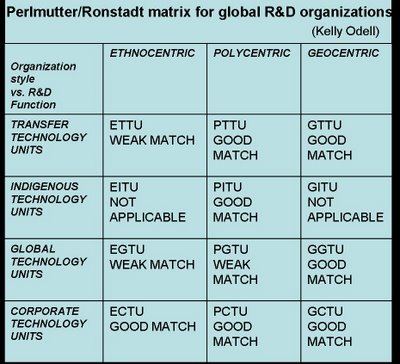
The following matrix illustrates one way in which global R&D can be discussed. It is of course possible that a corporation can manage its R&D activities differently depending on the type of technology unit. For example, a transfer technology unit might be treated polycentrically while a corporate technology unit may be managed geocentrically. However for the sake of this paper the various types of technology units will be discussed individually with no significant attention paid to the communication flows between the different types of technology units.
BACKGROUND
Creating the right organization and control system for R&D is always a difficult task even when confined to only one geographical location. Managing numerous R&D units spread all over the world increases the complexity dramatically. How well corporations coordinate their global R&D is one of the key factors for success in many industries.
Two crucial parameters must be defined in order to understand the methods for managing global R&D:
1) The various functions filled by R&D units
2) The different types of organizations that can be applied to these units
Types of global R&D laboratories
In order to understand the functions that can be filled by R&D units the descriptions used by Ronstadt (1977) as seen in de Meyer's and Mizushima's article Global R&D management (1989) will be referred to. Ronstadt's model is based on four types of R&D activities.
1) Transfer Technology Units or units established to help certain foreign subsidiaries transfer manufacturing technology from the parent while also providing related technical services for foreign customers.
2) Indigenous Technology Units or units established to develop new and improved products expressly for the foreign market. These products were not the direct result of new technology supplied by the parent organization.
3) Global Technology Units or units established to develop new products and processes for simultaneous application in major world markets of the company.
4) Corporate Technology Units or units established to generate new technology of a long term or exploratory nature expressly for the parent.
Types of organizations
To discuss the various organizations which can be used for global R&D, the model developed by Perlmutter (1965) as described in the book Managing the Global Firm by Bartlett, Doz and Hedlund (1990) will be applied. Although Perlmutter's model was developed to describe different types of organizations for multi-national corporations, it is not unreasonable to apply the same models to the organization of global R&D units.
Perlmutter's 3 organizational structures are:
1) Ethnocentric - overseas operations are managed primarily to protect the company's competitiveness in the home market. Communication and information is top down and all strategic decisions are steered from corporate headquarters. Subsidiaries sell products designed and manufactured by parent with little or no local control.
2) Polycentric - overseas subsidiaries take more responsibility adapting designs and manufacturing product to meet local needs. Subsidiaries are managed as independent units with minimum interference from headquarters.
3) Geocentric - all units of the organization are in close communication. Global market segments are defined and technology is transferred rapidly to sell more or less the same product worldwide maximizing economies of scale both in production and R&D.
EVALUATION
The Perlmutter/Ronstadt Matrix
The following matrix illustrates one way in which global R&D can be discussed. It is of course possible that a corporation can manage its R&D activities differently depending on the type of technology unit. For example, a transfer technology unit might be treated polycentrically while a corporate technology unit may be managed geocentrically. However for the sake of this paper the various types of technology units will be discussed individually with no significant attention paid to the communication flows between the different types of technology units.
Ethnocentric Transfer Technology Units (ETTU)
ETTU's assume that the subsidiary does some manufacturing for the local market. In an ethnocentric company the transfer of technology from the parent to subsidiary is based on the transfer of a finished design to be implemented in local production. This design was originally created to meet the needs of the parent company's home market and is transferred to the subsidiary in an opportunistic fashion. A positive reaction to this product from the market might be considered "good luck" because no real consideration was taken to local market need by the parent company. These R&D units could be located anywhere in the world, however, their responsibility is limited to adaption of the design from headquarters to the local manufacturing facility.
Ethnocentric Indigenous Technology Units (EITU)
The indigenous technology unit cannot exist by definition in an ethnocentric corporation since the local subsidiary would not be allowed the freedom to develop and manufacture product specifically for the local market. This type of operation could represent a transitory position from ethnocentric to polycentric.
Ethnocentric Global Technology Units (EGTU)
In the strictest sense EGTU's cannot exist since in an ethnocentric organization a global technology unit is based at the headquarters and although simultaneous introduction of new technology may occur to capitalize on global scale, the product is primarily designed to meet the needs of the home market.
Ethnocentric Corporate Technology Units (ECTU)
Corporate Technology units are quite compatible with ethnocentric organizations. The ECTU is located in the headquarters and is focused on securing the long-term development of new technology or evaluating applicability of alternative technologies and processes for the parent corporation.
Polycentric Transfer Technology Units (PTTU)
If the polycentric corporation maintains transfer technology units, they will be located in the headquarters and used to transfer product designs or manufacturing technology to the subsidiary to then be adapted by the local organization. If a subsidiary were to develop a technology or design that is applicable to another market, the transfer would take place via the PTTU at the headquarters since there is no mechanism for communication between subsidiaries.
Polycentric Indigenous Technology Units (PITU)
The indigenous technology unit fits best in a polycentric organization. The freedom that the polycentric organization allows is an excellent environment for the development and manufacturing of products specifically for the local market.
Polycentric Global Technology Units (PGTU)
To operate global technology units in a polycentric organization would be very difficult since the various local organizations are accustomed to making adaptations to fit their local markets. If, for example, a PGTU, were to develop a product to be applied simultaneously around the world, the design would need to be so flexible as to allow for local adaption and additional time must be allocated, not only for product adaptation, but also for internally selling the concept to the relatively independent polycentric subsidiaries.
Polycentric Corporate Technology Units (PCTU)
Corporate technology units in polycentric companies operate as suppliers to the local subsidiaries. Probably located at the headquarters, the PCTU would "sell" to or take assignments from the local R&D units to evaluate new technologies or materials. The PCTU functions as an advanced research laboratory for a number of more application oriented units in the subsidiaries.
Geocentric Transfer Technology Units (GTTU)
The transfer technology unit is extremely important if the geocentric organization is going to function successfully. Transfer technology units can be located anywhere and have the responsibility for surveying best practices or new innovations throughout the company and implementing them or cross fertilizing wherever applicable. The GTTU can be either a formal organization or an informal function of all R&D units.
Geocentric Indigenous Technology Units (GITU)
Although indigenous technology units could exist in a geocentric corporation, it is contra the fundamental goal of that type of organization. In a properly functioning geocentric R&D unit, no new product would be developed in a subsidiary without striving to incorporate the needs of the global market. It could occur that a market segment were defined in a local market that was not evident in any other market and that this segment was deemed important enough to justify a specific product being developed. In this case the development might be executed in the local development organization or in some other subsidiary where a special competence was maintained, thus the concept represented by the GITU is not truly applicable.
Geocentric Global Technology Units (GGTU)
Global technology units capitalize on the open communication between subsidiaries around the world to maximize global scales in R&D, manufacturing, and marketing. Although global technology units can function well even in ethnocentric organizations the geocentric corporation's ability to leverage a global base of technical know-how and human resources gives a clear competitive advantage.
Geocentric Corporate Technology Units (GCTU)
In a geocentric organization, corporate technology can be located in a single unit anywhere in the world or it may be comprised of several different units carrying the responsibility for different areas of technology. The corporate technology function may also be divided between a number of R&D units with specific product responsibility (i.e. global technology units) which manage a segment of the corporate technology function based on their unique competencies. For example a global technology unit that is primarily focused on developing a product that requires special heat resistant plastics may also be responsible for the corporate technology unit for all heat resistant plastics for the entire company.
CONCLUSIONS
It should be noted that this Perlmutter/Ronstadt matrix would require more in depth analysis in order to confirm its viability as an evaluation tool. In this brief analysis some general conclusions can be drawn.
Ethnocentric
The first and maybe most obvious conclusion is that ethnocentric R&D organisations are not functional on a global scale. This does not mean that a company with ethnocentric R&D is not a global competitor. A company may be a global leader in their industry, however this would imply an industry in which the product is a relatively unimportant element of the marketing mix. This could be true of such products as Coca Cola or Chanel perfume. Another alternative is that the company has created a temporary monopoly for example with patents as in the case Astra and Losec.
Polycentric
As regards polycentric and geocentric organisations it could be concluded that both are equally functional for global R&D but the choice of organisation styles depends greatly on the nature of the industry.
Polycentric organisations are particularly applicable to industries in which there are large variations in the needs of the market. The food industry is a good example where companies like Unilever and Nestlé must develop products that meet the local tastes of consumers around the world.
The key to the polycentric R&D organisation is the indigenous technology unit which carries the responsibility for creating products that secure the company's success in the local market. The transfer technology units work to avoid simultaneous development of products in different markets and to cross-fertilize best practices or to transfer new knowledge from the corporate technology units.
The corporate technology units fill a secondary, but important role to the indigenous technology units. The corporate technology unit is not under the pressures of supplying the market with new products and can therfore fill the role of technology consultants looking ahead, evaluating and developing fundamental technology that will be fed to the more operative R&D units locally.
Geocentric
A geocentric organization is advantageous for industries in which market needs can be defined or segmented globally with little or no variations from country to country. In fast pace industries with short product lifecycles, a geocentric organisation for R&D gives the benefit of developing a large number of competitive products for immediate global introduction. The geocentric R&D organisation is a child of modern times, completely dependent on high speed telecommunication, jet travel and computers.
The driver in this type of organisation is the global technology unit. These units must be well coordinated to avoid overlapping, however, properly managed the geocentric global technology units operate as one R&D department with a number of complimentary projects being executed simultaneously. Although inconvenienced by geographical distance, the project teams are in constant communication. The corporate technology units in a geocentric organisation are crucial and although they can be located anywhere in the world they should be clearly separated from the global technology units. This will ensure that the corporate technology units are focused on long term technology development which will secure the future of the corporation.
Saturday, July 22, 2006
Lie Number Three: "Our product is at the end of its lifecycle!"
Every product will eventually reach the end of its lifecycle. Some marketers use end of lifecycle as an excuse for there own lack of ability to address challenges of a competitive environment. Most products are not at the end of their life but need repeated rejuvenation. These rejuvenations are not really new lifecycles just product updates. A product like a Ford has been developed, recreated and improved many times over the years but I would argue that the fundamental product lifecycle of the Ford is still alive and kicking.
When your product has reached the end of its lifecycle you will know it! No one will want to buy your product or the products of your competitors. It won’t be a question of how to upgrade the product but how to replace it. In Sweden there is a classic example of a product that reached the end of its lifecycle the classic case of FACIT. FACIT manufactured the “adding machines” and realized far too late that electronic calculators would turn adding machines into one of the dinosaurs of the office. The adding machine truly reached the end of its product lifecycle. Most of us work with products and services that are not at the end of their lifecycles. If you begin to think your product is, it is probably just time for the next version.
When your product has reached the end of its lifecycle you will know it! No one will want to buy your product or the products of your competitors. It won’t be a question of how to upgrade the product but how to replace it. In Sweden there is a classic example of a product that reached the end of its lifecycle the classic case of FACIT. FACIT manufactured the “adding machines” and realized far too late that electronic calculators would turn adding machines into one of the dinosaurs of the office. The adding machine truly reached the end of its product lifecycle. Most of us work with products and services that are not at the end of their lifecycles. If you begin to think your product is, it is probably just time for the next version.
Wednesday, June 28, 2006
Lie Number Two: “We are a commodity industry”
You might argue that some industries really are commodity industries if they sell sand, iron ore or oil. I would argue that any business that succeeds for any period of time is surely differentiating itself in ways that are valued by its customers and therefore even if their products are highly commoditized their product offer is not.
I have heard people in many different industries say “we are a commodity industry”. Very early in my career I worked as an export sales manager for a small Swedish company that manufactured welding wire (basically just steel wire for those who don’t know). In that job I could argue for hours about why our product was better that the competitors and worth a small but very important premium. A great many customers paid that premium in order to improve the quality of their own products and manufacturing processes.
Some years later I spent 10 years with Whirlpool, the American whitegoods company, in various marketing and sales positions and let me tell you that people in that industry work very hard to differentiate their products. I don’t know how many times I’ve heard people say that a refrigerator is a refrigerator but the reality is that there is a great variety of appliances on the market and it is not the case that it is only the cheapest ones that sell. Even within what might be called a low-price segment competitors strive to differentiate their products.
Today, it is not uncommon to hear people talking about the commoditization of the telecom industry. On the surface it may appear that everyone is offering more or less the same thing: “A phone call is a phone call!” but nothing could be farther from the truth!
The other day I was talking to someone on the telephone. I was at my office but he was driving through the Swedish countryside in his car. He had a very bad connection and several times the call got cut off and he had to call me again. Finally, I asked him if he was a customer of my company (TeliaSonera). He admitted that he was not. He had recently switched from us to another operator because they offered him a slightly cheaper price-plan. My reply to him was that their price plan still seemed to be very expensive since their phone service was so poor. He laughed and we continued our conversation. A few days later he called and told me that he had changed back to my company. He had been thinking about what I had said and come to the realization that for a small difference in price he received much better quality of service from us. He said “I want to have a cell-phone so that I can make calls wherever I am and if it doesn’t work when I need it to I might as well not have one.” (In reality he probably paid more to the other operator with a poorer network since many price plans are more expensive to open a new call than to continue and old one.)
My point is that although many people talk about their business as if it were a commodity there are very few industries that truly are commodity industries. If you think you are working in a true “commodity industry” ask yourself why your company stays in business? What is your company’s competitive advantage? I think you will discover that although there may be great similarity between the products and services you and your competitors sell the actual offering you make to your customers may vary greatly. Your company may be perceived as being more reliable, giving better service or maybe just more likeable than your competitors. Whatever the differentiators are they are valuable and must be developed and managed. Customers don’t buy products they buy an offer that satisfies their needs. Even if your product truly is a commodity your offer to the customer which includes the commodity may very well be unique.
I have heard people in many different industries say “we are a commodity industry”. Very early in my career I worked as an export sales manager for a small Swedish company that manufactured welding wire (basically just steel wire for those who don’t know). In that job I could argue for hours about why our product was better that the competitors and worth a small but very important premium. A great many customers paid that premium in order to improve the quality of their own products and manufacturing processes.
Some years later I spent 10 years with Whirlpool, the American whitegoods company, in various marketing and sales positions and let me tell you that people in that industry work very hard to differentiate their products. I don’t know how many times I’ve heard people say that a refrigerator is a refrigerator but the reality is that there is a great variety of appliances on the market and it is not the case that it is only the cheapest ones that sell. Even within what might be called a low-price segment competitors strive to differentiate their products.
Today, it is not uncommon to hear people talking about the commoditization of the telecom industry. On the surface it may appear that everyone is offering more or less the same thing: “A phone call is a phone call!” but nothing could be farther from the truth!
The other day I was talking to someone on the telephone. I was at my office but he was driving through the Swedish countryside in his car. He had a very bad connection and several times the call got cut off and he had to call me again. Finally, I asked him if he was a customer of my company (TeliaSonera). He admitted that he was not. He had recently switched from us to another operator because they offered him a slightly cheaper price-plan. My reply to him was that their price plan still seemed to be very expensive since their phone service was so poor. He laughed and we continued our conversation. A few days later he called and told me that he had changed back to my company. He had been thinking about what I had said and come to the realization that for a small difference in price he received much better quality of service from us. He said “I want to have a cell-phone so that I can make calls wherever I am and if it doesn’t work when I need it to I might as well not have one.” (In reality he probably paid more to the other operator with a poorer network since many price plans are more expensive to open a new call than to continue and old one.)
My point is that although many people talk about their business as if it were a commodity there are very few industries that truly are commodity industries. If you think you are working in a true “commodity industry” ask yourself why your company stays in business? What is your company’s competitive advantage? I think you will discover that although there may be great similarity between the products and services you and your competitors sell the actual offering you make to your customers may vary greatly. Your company may be perceived as being more reliable, giving better service or maybe just more likeable than your competitors. Whatever the differentiators are they are valuable and must be developed and managed. Customers don’t buy products they buy an offer that satisfies their needs. Even if your product truly is a commodity your offer to the customer which includes the commodity may very well be unique.
Sunday, June 25, 2006
Lie Number One: Price Erosion
Inspired by Guy Kawasaki’s talent for identifying the “untruths” of the business world I thought I would try my hand at a few. The first on is the illusion of price erosion.
Prices do not erode! What erodes is a company’s ability to be more successful than their competitors at satisfying customers. So called price erosion doesn’t happen to individual companies, it happens to entire industries. When an industry experiences price erosion it is really an expression of the fact the players in the industry are achieving less and less diversification between themselves. When everyone offers what appear to be more or less the same products and services prices fall. Price erosion is only a symptom or evidence of the lack of innovation within an industry. Managers will sometimes justify lower revenue and weaker margins by proclaiming that they are victims of price erosion. You never hear them say prices are down to due their lack of ability to outpace their competitors!
Continuous improvement in value creation is hard. Lowering prices is easy! Most companies find themselves in situations where they are compelled to lower prices in order to maintain their customer base from time to time. Short-term profit margins can be maintained by reducing costs but long-term, the only way to earn more money is by creating more value for your customers. At some point in time you will reach a level of efficiency where cost reductions erode the value of the customer offer and only lead to further price reductions without additional margin. Many companies discover that although their margins are the same as a percentage they have declined drastically in real money.
If you feel compelled to talk about price erosion, make sure you keep in mind that it is only a symptom. If putting a label on the symptom helps you better understand the illness then power to you but don’t neglect the reality that your prices are eroding because your business is losing its competitive edge.
Prices do not erode! What erodes is a company’s ability to be more successful than their competitors at satisfying customers. So called price erosion doesn’t happen to individual companies, it happens to entire industries. When an industry experiences price erosion it is really an expression of the fact the players in the industry are achieving less and less diversification between themselves. When everyone offers what appear to be more or less the same products and services prices fall. Price erosion is only a symptom or evidence of the lack of innovation within an industry. Managers will sometimes justify lower revenue and weaker margins by proclaiming that they are victims of price erosion. You never hear them say prices are down to due their lack of ability to outpace their competitors!
Continuous improvement in value creation is hard. Lowering prices is easy! Most companies find themselves in situations where they are compelled to lower prices in order to maintain their customer base from time to time. Short-term profit margins can be maintained by reducing costs but long-term, the only way to earn more money is by creating more value for your customers. At some point in time you will reach a level of efficiency where cost reductions erode the value of the customer offer and only lead to further price reductions without additional margin. Many companies discover that although their margins are the same as a percentage they have declined drastically in real money.
If you feel compelled to talk about price erosion, make sure you keep in mind that it is only a symptom. If putting a label on the symptom helps you better understand the illness then power to you but don’t neglect the reality that your prices are eroding because your business is losing its competitive edge.
Monday, June 12, 2006
Born to Lead or Bats in the Belfry
Some years ago I joined the management team of a new division that had been created in the company I worked in at that time. The head of that division gathered his new management team for our first off-site meeting so that we could "team build". Our new boss opened this meeting by saying that he had hand picked each one of us because during our working lives we had developed into good leaders. He then continued by saying that he had be born to be a leader. He explained how it had been apparent to everyone as a child on the school playground that he was a born leader. We listened to a number of stories from throughout his life that exemplified his exceptional leadership. We were to understand that although we were all good leaders, he was a "born" leader (apparently in his mind equal to "great" leader").
I won't comment on whether or not my old boss was born with, or ever developed any leadership qualities. One thing he did, however, seem to have been born without was good common sense. This weakness seems to afflict many top managers and politicians. I am never really surprised that people get crazy thoughts in their heads. I know I often have absolutely ridiculous nonsense gallivanting around the corridors of my mind. What surprises me is that many people lack the judgment to keep these absurd notions for themselves! If my boss really believed he was the greatest thing to happen to leadership since Napoleon you would have thought he would also have realized that this revelation would sound a bit farfetched for his employees who were only moderately gifted.
This blog entry skirts the issue of whether or not leaders are born or created. It is highly likely that some people may be born with more of certain qualities that give them a head start at becoming a good leader but there seems to be very little agreement in management literature about what these qualities are. In fact about the only thing that everyone seems to agree on is that there are many different successful leadership styles. Another factor that seems to be common in all successful leadership styles is empathy. The ability to understand the wants and desires of others seems to be a success factor for all types of leaders including those who use their leadership solely for their own benefit and the oppression of others. Machiavellistic leaders as well as altruistic leaders have great advantage of a highly developed empathy.
The short of it is that no one really knows how great leaders are made. We know only slightly more about what traits are characteristic of great leaders. My suggestion is that if little voices in your head are telling you that you were born to lead, ignore them!
I won't comment on whether or not my old boss was born with, or ever developed any leadership qualities. One thing he did, however, seem to have been born without was good common sense. This weakness seems to afflict many top managers and politicians. I am never really surprised that people get crazy thoughts in their heads. I know I often have absolutely ridiculous nonsense gallivanting around the corridors of my mind. What surprises me is that many people lack the judgment to keep these absurd notions for themselves! If my boss really believed he was the greatest thing to happen to leadership since Napoleon you would have thought he would also have realized that this revelation would sound a bit farfetched for his employees who were only moderately gifted.
This blog entry skirts the issue of whether or not leaders are born or created. It is highly likely that some people may be born with more of certain qualities that give them a head start at becoming a good leader but there seems to be very little agreement in management literature about what these qualities are. In fact about the only thing that everyone seems to agree on is that there are many different successful leadership styles. Another factor that seems to be common in all successful leadership styles is empathy. The ability to understand the wants and desires of others seems to be a success factor for all types of leaders including those who use their leadership solely for their own benefit and the oppression of others. Machiavellistic leaders as well as altruistic leaders have great advantage of a highly developed empathy.
The short of it is that no one really knows how great leaders are made. We know only slightly more about what traits are characteristic of great leaders. My suggestion is that if little voices in your head are telling you that you were born to lead, ignore them!
Wednesday, June 07, 2006
I Believe
Many years ago in College one of the assignments we were asked to do was to prepare a "Kleine Credo" or little belief system. The assignment was to write a short essay of no more than 1-2 pages describing our personal religious beliefs. It wasn’t a strange assignment since I was in a class on New Testament theology while working on a degree in Religion. ( I won’t bore you with the contents of that Kleine Credo.)
Many years later I was asked to speak to a group of employees who were going to be representing our company at a large trade show. The organizers asked me to talk about how to meet customers and give them good service. It occurred to me that it might help to remind these colleagues of just how important the work we do at our company really is and I decided to write a new Kleine Credo expressing my own opinions about the Telecom industry. Since then I have shown this for groups of people in all industries. If you cannot see how your industry is contributing to making the world a better place my recommendation is to change industry! What do you believe?
I Believe...
I believe that global competition promotes world peace.
I believe the telecom industry contributes significantly to world trade creating better opportunities to improve the quality of life for people around the world.
I believe the telecom industry facilitates better communication and greater understanding between people around the world.
I believe that we are all important members of a large group of people from around the world who have decided to cooperate in order to create these values, to create better world!
Many years later I was asked to speak to a group of employees who were going to be representing our company at a large trade show. The organizers asked me to talk about how to meet customers and give them good service. It occurred to me that it might help to remind these colleagues of just how important the work we do at our company really is and I decided to write a new Kleine Credo expressing my own opinions about the Telecom industry. Since then I have shown this for groups of people in all industries. If you cannot see how your industry is contributing to making the world a better place my recommendation is to change industry! What do you believe?
I Believe...
I believe that global competition promotes world peace.
I believe the telecom industry contributes significantly to world trade creating better opportunities to improve the quality of life for people around the world.
I believe the telecom industry facilitates better communication and greater understanding between people around the world.
I believe that we are all important members of a large group of people from around the world who have decided to cooperate in order to create these values, to create better world!
Friday, June 02, 2006
Personify your product!
I was asked to speak to a group of marketing graduate students about how I used market research in my work as a product manager. As I recall I spent most of the lecture showing examples of various research we had done and how that research had helped us make necessary decisions. During this presentation two things popped out of my mouth which I had previously not thought about very much consciously prior to that day but which I have come to believe more and more strongly throughout my working life.
"A marketer should live the life of their product" or "embody their product", "personify their product"…something like that…
In highly competitive industries marketing decisions must often be made very quickly. There will not be time to do in depth analysis on every issue but a marketer who is immersed in their product and who understands the industry dynamics of their business will make the right intuitive decisions when the time comes.
"A marketer should live the life of their product" or "embody their product", "personify their product"…something like that…
In highly competitive industries marketing decisions must often be made very quickly. There will not be time to do in depth analysis on every issue but a marketer who is immersed in their product and who understands the industry dynamics of their business will make the right intuitive decisions when the time comes.
Monday, May 29, 2006
There is No Escape from Marketing!
I ran across Stan DeVaughn's blog entry from February 27, 2006 with the title "Marketing and Branding are high-tech wrecks" and can simply say that I couldn't have put it better myself. So many high-tech companies once founded upon their discovery of a "real" need over time seem to lose the ability to think outside in.
If you are a dyed in the wool marketeer working in a truly marketing driven organization you will have nothing to learn from this blog entry. If you are a marketing novice or a true marketeer working in a technology driven company you might want to keep reading.
Marketing has nothing to do with organization. Companies choose to organize the work of marketing in many different ways. Some companies gather all of Kotler's Ps (Product, Price, Place, Promotion) in the same organization while other companies have a marketing department managing advertising and the rest of the Ps are distributed throughout the organization. (Some companies don't even have a marketing department.)
Marketing describes how companies understand customer needs and satisfy them for a profit. To paraphrase Kotler marketing is all about what product to sell …to which customer…at what price….how will the customer find out about the product, buy it and get it delivered? (And what will the competitors do about it?) All companies do marketing. Whether it be done poorly or well, consciously or unconsciously marketing cannot be escaped. No matter how your particular organization organizes the work of marketing success depends on your ability to manage the balance and/or trade offs between the 4 Ps (the marketing mix).
Imagine a company where a market research department works with customer insight to identify customer needs, a product development department creates new products, a pricing manager sets the prices for the products, a market communications department does the advertising and the sales department defines a distribution strategy. So far so good?
Now imagine that none of these groups coordinate their activities with each other and in the event that they ever do meet it is not clear who really makes the decisions. These companies do exist and most often the people running the show in companies like this are the product development people. In the end they are making products with little or no input from the people with the customer insight and the rest of the organization has to do their best to try and sell them or the company will go bust. These types of companies are doing marketing (albeit poorly) whether they realize it or not. Because product development has created products that were not optimized to customer needs the company will compensate by increasing advertising expenditures and paying higher commissions to its dealers and/or with lower prices to the end users. This is managing the marketing mix.
Imagine, on the other hand, a company where the people with the customer insight (not the salespeople) are defining the requirements on new products including retail pricing, commisions and gross margin. Product development creates the defined product with the right performance and price. Promotion of this product will be very cost effective since the product so clearly meets the customers real needs at a reasonable price making the sales departments job much easier. Companies like this do exist and they are usually the leaders in their industries or they are hungry small companies de-throning the old industry leaders.
If you would like to read more of my thoughts on marketing have a look at the following:
The World's Shortest Marketing Plan
THE MARKETING PLAN: THE GOOD THE BAD AND THE UGLY
If you are a dyed in the wool marketeer working in a truly marketing driven organization you will have nothing to learn from this blog entry. If you are a marketing novice or a true marketeer working in a technology driven company you might want to keep reading.
Marketing has nothing to do with organization. Companies choose to organize the work of marketing in many different ways. Some companies gather all of Kotler's Ps (Product, Price, Place, Promotion) in the same organization while other companies have a marketing department managing advertising and the rest of the Ps are distributed throughout the organization. (Some companies don't even have a marketing department.)
Marketing describes how companies understand customer needs and satisfy them for a profit. To paraphrase Kotler marketing is all about what product to sell …to which customer…at what price….how will the customer find out about the product, buy it and get it delivered? (And what will the competitors do about it?) All companies do marketing. Whether it be done poorly or well, consciously or unconsciously marketing cannot be escaped. No matter how your particular organization organizes the work of marketing success depends on your ability to manage the balance and/or trade offs between the 4 Ps (the marketing mix).
Imagine a company where a market research department works with customer insight to identify customer needs, a product development department creates new products, a pricing manager sets the prices for the products, a market communications department does the advertising and the sales department defines a distribution strategy. So far so good?
Now imagine that none of these groups coordinate their activities with each other and in the event that they ever do meet it is not clear who really makes the decisions. These companies do exist and most often the people running the show in companies like this are the product development people. In the end they are making products with little or no input from the people with the customer insight and the rest of the organization has to do their best to try and sell them or the company will go bust. These types of companies are doing marketing (albeit poorly) whether they realize it or not. Because product development has created products that were not optimized to customer needs the company will compensate by increasing advertising expenditures and paying higher commissions to its dealers and/or with lower prices to the end users. This is managing the marketing mix.
Imagine, on the other hand, a company where the people with the customer insight (not the salespeople) are defining the requirements on new products including retail pricing, commisions and gross margin. Product development creates the defined product with the right performance and price. Promotion of this product will be very cost effective since the product so clearly meets the customers real needs at a reasonable price making the sales departments job much easier. Companies like this do exist and they are usually the leaders in their industries or they are hungry small companies de-throning the old industry leaders.
If you would like to read more of my thoughts on marketing have a look at the following:
The World's Shortest Marketing Plan
THE MARKETING PLAN: THE GOOD THE BAD AND THE UGLY
Friday, May 26, 2006
The "Behave-Atudes"
A strong understanding of your customer’s behaviours and attitudes as they relate to the products and services you sell is one of the keys to successful segmentation and the success of your business. Many large companies (with large resources) develop sophisticated processes for segmenting customers based on behaviours including quantitative and qualitative research, data mining and complex analysis models. Many refer to these segmentation models as “Needs Based” segmentation, however, the needs are normally never really identified but rather extrapolated (guessed at) from demonstrated behaviours and or attitudes.
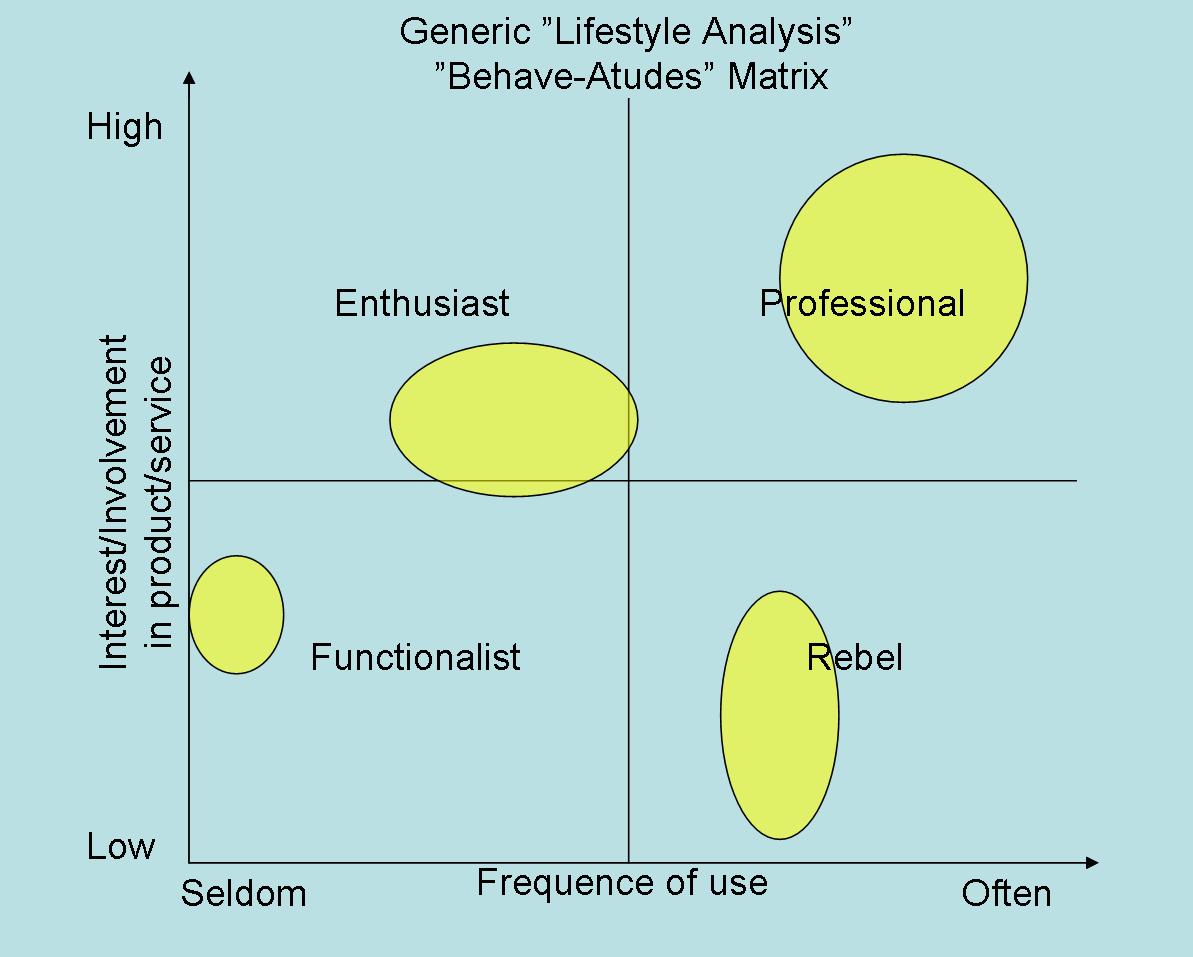
When trying to understand the fundamentals of your customer’s behaviours and attitudes regarding your products and services two key parameters should be evaluated. How interested or how engaged are they and how frequently do they use the product or service.

The diagram demonstrates the four generic behavioural/attitude (Behav-Atudes) categories that can be found in most industries. Depending on your specific product or service the size of each group will vary but you will likely be surprised to find that there is almost always a sizeable group in each category. The offerings you make to each group as well as the way you communicate to each of these groups should be adapted to their specific behaviour/attitudinal position. Identifying your customers Behav-Atudes can give you a real competitive advantage or even lead to discovering new ways to solve the customers underlying needs by substitution making your products obsolete and redefining your industries.
The Four Generic “Behave-Atudes”
( You will likely find names for the Behave-Atudes that describe your customers from your industry perspective that are much better. Feel free!)
Professional
Individuals who are actively interested and frequent users of products and services like yours could be called Professionals. Not because they necessarily use your products in their professions but because they are typical very knowledgeable and have strong opinions based on a great deal of real experience of the products or services. Insight gained from these users can contribute significantly to further product development. Branding is very important.
Enthusiast
Enthusiasts are people who are very interested but not frequent users. Among these you will find people who have expensive kitchens but who eat most of their meals in restaurants or people that have a fully equipped carpentry workshop in their garage for hobby use. These users can be very talented and sophisticated despite having less “real” experience than the professional. Branding is important in this group.
Funtionalist
These people will use your products and services occasionally but are really not interested in the products. As long as the product works they really don’t care very much about design, branding or extra accessories. Simplicity is key with these customers since these users will not spend time learning to use your products or services.
Rebel
Rebels use your products and services often but are not at all interested in them. They may drive their car much more than the average car owner or use their cell-phone much more than other people but they view the product only as an means to an end. These users view products in the same category as commodities and are very price conscious. They seek basic functionality and ease of use. It is not uncommon to find users with negative attitudes about your products despite being frequent users. These people often feel forced into using the product or service.
When trying to understand the fundamentals of your customer’s behaviours and attitudes regarding your products and services two key parameters should be evaluated. How interested or how engaged are they and how frequently do they use the product or service.
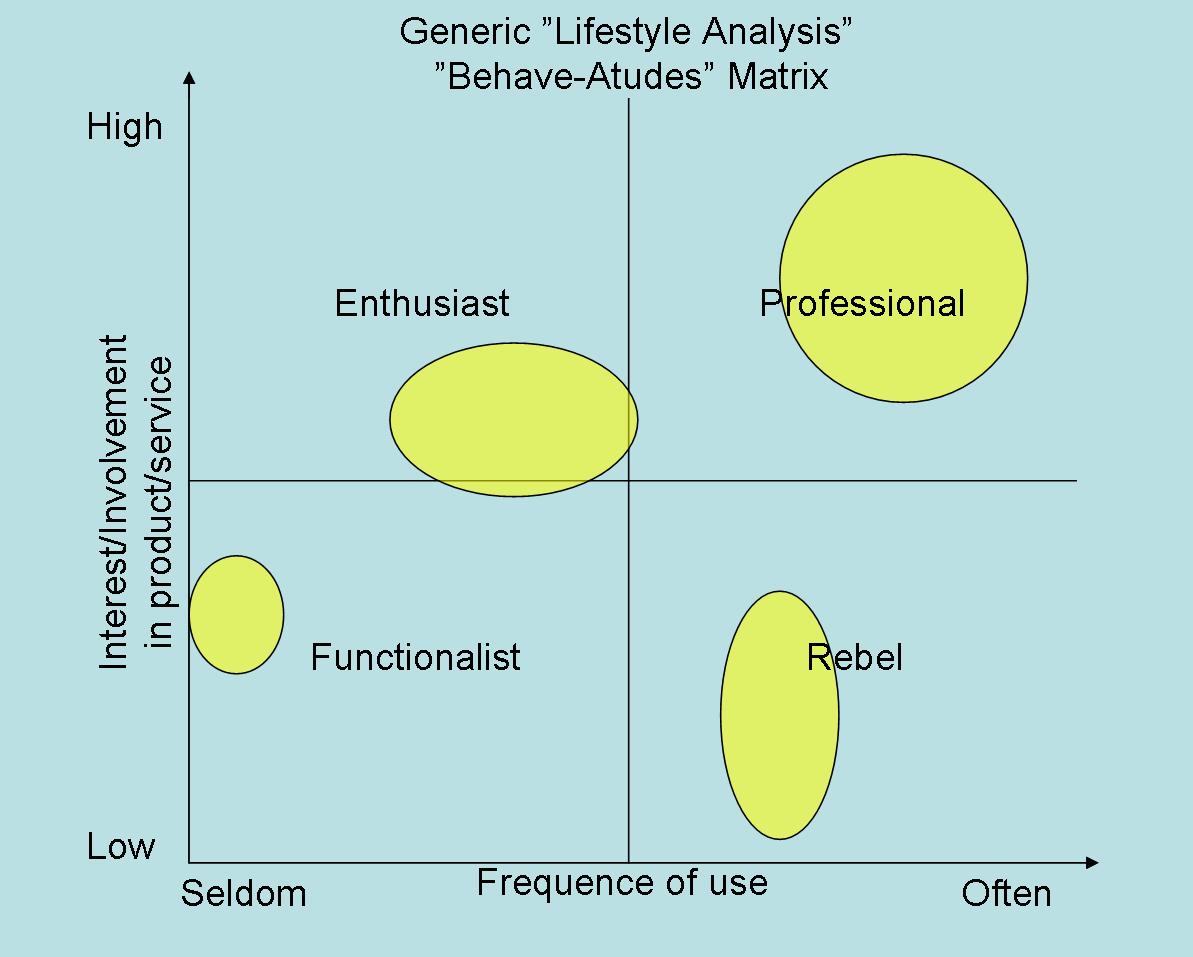
The diagram demonstrates the four generic behavioural/attitude (Behav-Atudes) categories that can be found in most industries. Depending on your specific product or service the size of each group will vary but you will likely be surprised to find that there is almost always a sizeable group in each category. The offerings you make to each group as well as the way you communicate to each of these groups should be adapted to their specific behaviour/attitudinal position. Identifying your customers Behav-Atudes can give you a real competitive advantage or even lead to discovering new ways to solve the customers underlying needs by substitution making your products obsolete and redefining your industries.
The Four Generic “Behave-Atudes”
( You will likely find names for the Behave-Atudes that describe your customers from your industry perspective that are much better. Feel free!)
Professional
Individuals who are actively interested and frequent users of products and services like yours could be called Professionals. Not because they necessarily use your products in their professions but because they are typical very knowledgeable and have strong opinions based on a great deal of real experience of the products or services. Insight gained from these users can contribute significantly to further product development. Branding is very important.
Enthusiast
Enthusiasts are people who are very interested but not frequent users. Among these you will find people who have expensive kitchens but who eat most of their meals in restaurants or people that have a fully equipped carpentry workshop in their garage for hobby use. These users can be very talented and sophisticated despite having less “real” experience than the professional. Branding is important in this group.
Funtionalist
These people will use your products and services occasionally but are really not interested in the products. As long as the product works they really don’t care very much about design, branding or extra accessories. Simplicity is key with these customers since these users will not spend time learning to use your products or services.
Rebel
Rebels use your products and services often but are not at all interested in them. They may drive their car much more than the average car owner or use their cell-phone much more than other people but they view the product only as an means to an end. These users view products in the same category as commodities and are very price conscious. They seek basic functionality and ease of use. It is not uncommon to find users with negative attitudes about your products despite being frequent users. These people often feel forced into using the product or service.
Friday, May 19, 2006
Corporate Spirituality
At first glance it is tempting to conclude that people in large parts of the developed world have become less religious. The question is, however, if we haven't simply changed religions. Could it be that we are just as religious as ever but the focus of our worship is different, our ceremonies and rituals are clothed in other symbols and our clergymen are found in other institutions? In William James book "The Varieties of Religious Experience" he states that religion is "the feellings, acts, and experiences of individual men in their solitude, so far as they apprehend themselves to stand in relation to whatever they may consider the divine". He goes on to define "divine" as whatever the individual "felt to be the primal truth". With these definitions of religion it becomes much easier to begin to identify our new gods and religious practices. In fact, I suspect that there are a great many new religions which are fullfilling mans need for religious experience. However, I will keep my focus on the modern business environment. There is a strong argument that the business world of today is built upon a largely spiritual foundation and that there exists a corporate religion which is the glue holding these organisations and even entire market systems in order.
It is not my ambition to condescend those activities and institutions of business life that will be discussed here. Nor is it my goal to ridicule the "traditional religions" or religious people. My goal here is to attempt to understand business life, management, and organisation from a different point of view. One that might give us better insight into the workings of the organization as well as the individuals that comprise them. Management theorie has been primarily scientific in its approach. This has led to a great number of theoretical models of organizations from more or less scientific orgins. In "Images of Organization" by Gareth Morgan the point is made that the metaphors we use in decribing an organization imply " a way of thinking and a way of seeing that prevade how we understand our world generally". Any metaphor we choose will open possibilities but also create limitations. A metaphor is by definition "like" or similar to the object of comparison. It is not the same as that object and therefore even if it may given insight as to how the organization works it will also mislead. The problem is then to ascertain which of the "insights" are correct and which are faulty. By trying to understand organizations and business life as religious expression we may find ourselves in the same perdicament, however, there is a good chance that this will not fall into the same trap as other metaphors because it may not be a metaphor. I could be that our business life is in fact a part of mans search for meaning and his attempt to fill his spiritual needs.
In an earlier blog entry i introduced the “Holy Trinity of Sustainable Growth” (Customer, Employee and Shareholder) in which I argue that over the long-term it is impossible to create value for one of these stakeholder groups without creating value for all of them. As with the “Holy Trinity of Christianity” most of us cannot credibly describe the relationship between the three entities even though we believe there is a relationship. Everyday we hear references to “the market”. There are events that happen in the market or we are told that the market has behaved in one way or the other. Has this market become our new god? A vague entity that effects all of our lifes. An entity that is omnipresent (everywhere at once) and as close to omniscient (all knowing) as anything else we know.
Business gurus are the priests of our time and weild as much power over society as the priests did hundreds or thousands of years ago. Our holy scripture might be described as a limited number of books by a few holy apostles like Maslow, Pavlov, Kotler, Porter, Kotter and Drucker. Everything else written in management literature could be seen as exergesis on these apostles fundamental themes.
In my own management experience I find that it is much easier to gain acceptance for my theories or “beliefs” than it is to get critical, analytical views. It seems to be easier to believe than to think and analyze.
We need to be alert to the fact that we humans find ourselves so easily believing. We must learn to exercise our free wills and our intellects to continuously question and analyze reality as best we can perceive it and make the best possible decisions from time to time. Companies that strive to create a common belief system risk eliminating critical thought and will surely loose their competitive edge.
It is not my ambition to condescend those activities and institutions of business life that will be discussed here. Nor is it my goal to ridicule the "traditional religions" or religious people. My goal here is to attempt to understand business life, management, and organisation from a different point of view. One that might give us better insight into the workings of the organization as well as the individuals that comprise them. Management theorie has been primarily scientific in its approach. This has led to a great number of theoretical models of organizations from more or less scientific orgins. In "Images of Organization" by Gareth Morgan the point is made that the metaphors we use in decribing an organization imply " a way of thinking and a way of seeing that prevade how we understand our world generally". Any metaphor we choose will open possibilities but also create limitations. A metaphor is by definition "like" or similar to the object of comparison. It is not the same as that object and therefore even if it may given insight as to how the organization works it will also mislead. The problem is then to ascertain which of the "insights" are correct and which are faulty. By trying to understand organizations and business life as religious expression we may find ourselves in the same perdicament, however, there is a good chance that this will not fall into the same trap as other metaphors because it may not be a metaphor. I could be that our business life is in fact a part of mans search for meaning and his attempt to fill his spiritual needs.
In an earlier blog entry i introduced the “Holy Trinity of Sustainable Growth” (Customer, Employee and Shareholder) in which I argue that over the long-term it is impossible to create value for one of these stakeholder groups without creating value for all of them. As with the “Holy Trinity of Christianity” most of us cannot credibly describe the relationship between the three entities even though we believe there is a relationship. Everyday we hear references to “the market”. There are events that happen in the market or we are told that the market has behaved in one way or the other. Has this market become our new god? A vague entity that effects all of our lifes. An entity that is omnipresent (everywhere at once) and as close to omniscient (all knowing) as anything else we know.
Business gurus are the priests of our time and weild as much power over society as the priests did hundreds or thousands of years ago. Our holy scripture might be described as a limited number of books by a few holy apostles like Maslow, Pavlov, Kotler, Porter, Kotter and Drucker. Everything else written in management literature could be seen as exergesis on these apostles fundamental themes.
In my own management experience I find that it is much easier to gain acceptance for my theories or “beliefs” than it is to get critical, analytical views. It seems to be easier to believe than to think and analyze.
We need to be alert to the fact that we humans find ourselves so easily believing. We must learn to exercise our free wills and our intellects to continuously question and analyze reality as best we can perceive it and make the best possible decisions from time to time. Companies that strive to create a common belief system risk eliminating critical thought and will surely loose their competitive edge.
Thursday, May 11, 2006
Drugs, Sex and Rock n Roll (continued)
I received a comment from Kfir Pravda asking me to clarify my view on how fundamental human needs drive decision making in a B2B environment. (To see the original blog entry click here)
Following is my response:
All businesses are either providing a product or service which directly satisfies a “real” customer need or they are part of a value chain that in the end will satisfy that need. Nobody really wants to buy a complex managed service solution or a rock crusher. The only “rational” reason for buying either of these is that they in some way make it easier for you to satisfy your customer and your customer should never buy your product if it doesn’t in some way improve their offer to their customer and so on!. In highly competitive industries (virtually all industries) understanding the full value chain from beginning to end can give you the insight to gain a competitive advantage over others who are simply focused on their part of the value chain.
All decision makers are human and base decisions on what satisfies their needs. Decision makers in B2B environments understand what requirements need to be fulfilled in purchasing a managed service or a rock crusher. Even if the requirements are expressed in technical and economic terms the underlying motivations of the decision makers are Maslowian. They want to be perceived as talented, successful, get bigger bonuses, promotions, etc. Sellers in B2B should always be thinking about how they can make the decision makers life better!
Following is my response:
All businesses are either providing a product or service which directly satisfies a “real” customer need or they are part of a value chain that in the end will satisfy that need. Nobody really wants to buy a complex managed service solution or a rock crusher. The only “rational” reason for buying either of these is that they in some way make it easier for you to satisfy your customer and your customer should never buy your product if it doesn’t in some way improve their offer to their customer and so on!. In highly competitive industries (virtually all industries) understanding the full value chain from beginning to end can give you the insight to gain a competitive advantage over others who are simply focused on their part of the value chain.
All decision makers are human and base decisions on what satisfies their needs. Decision makers in B2B environments understand what requirements need to be fulfilled in purchasing a managed service or a rock crusher. Even if the requirements are expressed in technical and economic terms the underlying motivations of the decision makers are Maslowian. They want to be perceived as talented, successful, get bigger bonuses, promotions, etc. Sellers in B2B should always be thinking about how they can make the decision makers life better!
Tuesday, May 09, 2006
The Paradigm Erupts (The disruption of the Telecom industry)
The great philosopher Leibniz (born 1670) said “Reality cannot be found except in One single source, because of the interconnection of all things with one another.” Although certainly not his intention this statement rings true for the Telecom or IT industries today. In the very near future everything from our breakfast cereal to our heartbeats will be connected.
What if telephones of the future will be no larger than a dime and cost less than a dollar?
If telephones could be very small and very inexpensive would we still have only one telephone each or would we have hundreds? Would they just be laying around everywhere or would they be built in as an extra feature or component of all sorts of other products?
What if our customer identity moves out of the SIM-card and into our driver’s license or maybe in a “chip” implanted under the skin on our neck. (My cat has one and horses often have them.) If someone would borrow your telephone, the telephone will automatically identify them and charge whatever calls they make to their bill. While they use your phone they have access to all of there own telephone numbers, calendar and anything thing else they want to access (files, entertainment, photos, music, whatever). When you take the phone back it switches back to your identity and your content. In short, what if you have access to all of your personal content with whatever device you have access to wherever you happen to be without the limitations of the memory capacity of the device?
When I connect my customer identity to a device the size of a dime and lay that little phone on top of a TV or a PC or a screen in my car or a Palm in my pocket I can see my content. None of this is technologically farfetched, however, there is still a great deal to do on the commercial side of things to understand what products and services with which business models will generate revenue for what companies.
There is a convergence of everything to everything.
Telephones have become computers and computers have become telephones. We can watch TV on phones or over the internet! Any decent telephone contains a camera and a Mp3 player. Cameras are getting SIM-cards so they can automatically send your photos to your computer or your server supplier. Some gurus claim that this is not really convergence but divergence. To avoid getting caught up in semantics, maybe the best thing is to say that from a technology perspective things are changing rapidly.
New disruptive technologies will impact the way we work and play as individuals! They will create great opportunities for some companies and spell out doom for others. Although it is relatively easy to see these changes happening at a macro level it is enormously difficult (impossible) to say which companies will win. It is equally difficult to know exactly what technologies to bank on or which new business models will succeed.
What are the keys to success in this brand new world or maybe I should say in this new brand world? Customers and brands have always been important and I will not fall for the temptation of saying they will be more important in the future. However, the role of brands is changing as are the tools we use to build brands. TV advertising has been the most powerful tool for building strong consumer brands for 50 years. Viewers are opting out of traditional TV for other forms of entertainment or they are fast forwarding or simply hoping over commercials on digital channels. New media consumption behaviors require new marketing know-how. Consumers are becoming immune to traditional brand promises. Volvo’s promise of safety has gone from a powerful driver of the brand to being a prerequisite for any carmaker competing in that customer segment. Whatever else a BMW, Mercedes or Volvo may aspire to be in the hearts and minds of their customers they must also me safe.
This is not a paradigm shift, it is a paradigm eruption!
The expression “paradigm shift” at best creates a mental picture of one state of things that will shift to another state. What we are witnessing is more like an eruption in which there are so many parameters and so much change happening simultaneously that it can hardly be called a shift. When the dust settles many of the winners (not all) will simply have been lucky. They will have gambled on the right technologies and services. Organizations need a certain amount of stability to operate. The agenda cannot be changed completely everyday! Paradoxically, despite the fact that technology is radically changing the way we live and work, our fundamental human needs remain the same. Here we find the underlying stability we need to run our businesses. Fundamental human needs change very slowly, if at all. I am sure that a traveling business man in Roman times would have wanted to call home to his wife and his office if he could have. The need was there but the technical solution was not. As technology advances we find better ways to satisfy our needs. Our behaviors change but the needs that drive these behaviors do not.
Maslow will move from the marketing department to the boardroom
Companies who build their visions and strategies around satisfying these fundamental needs by means of whatever technologies best happen to suit them at the time will succeed. Companies who entrench themselves in technologies and then look for commercially viable applications will falter. Maslow will reign supreme and move from the marketing department to the boardroom.
Tips for success in this “New Brand World”!
Focus on fundamental human needs
-Shift from acquisition to retention (Anyone can win a customer, winners keep them)
Be open minded
-Don’t defend old technical solutions or business models (Kill your darlings)
-Accept that you don’t know what tomorrow holds
Experiment
-Failures are inevitable! Expect, Accept, Celebrate and Learn from them!
-Move on!
Have Fun!
Be fearless in the face of change. It’s a great business!
Thursday, May 04, 2006
The World's Shortest Marketing Plan Version 2.1
I am learning everyday about the power of the digital universe. A couple weeks ago I published my "World's Shortest Marketing Plan" where I gave myself the challenge of making a marketing plan template that was reasonably comprehensive and could fit on a single powerpoint page. This was my reaction to many of the marketing plan templates I have seen and worked with that are just to long and complicated to get your arms around even as a seasoned marketer and damn near impossible for a novice.
My short template got some attention on my blog and then I got an email from Guy Kawasaki, one of the true business blog gurus. Guy suggested that we adapt my template with a new version of the 4Ps created by another blogger named John Sviokla. John’s 5Ps do a great job bringing Kotler into the digital universe. His blog is well worth the read!
In short Guy improved the content of Kelly’s blog by adapting it with content from John’s blog.
Following is the new hybrid! Let me know what you think and do take a look at Guy and John’s blogs!
To view a word document version click here.
My short template got some attention on my blog and then I got an email from Guy Kawasaki, one of the true business blog gurus. Guy suggested that we adapt my template with a new version of the 4Ps created by another blogger named John Sviokla. John’s 5Ps do a great job bringing Kotler into the digital universe. His blog is well worth the read!
In short Guy improved the content of Kelly’s blog by adapting it with content from John’s blog.
Following is the new hybrid! Let me know what you think and do take a look at Guy and John’s blogs!
To view a word document version click here.
If you ever get anything right it was probably a mistake
“Stand still, I'm trying to shoot you!”
Some years ago I took a course to get a hunting license. One of the things we had to do to qualify for the license was to shoot a paper target shaped like a moose moving back and forth on a track at a distance of 80 meters. The target area on the moose was about the size of a basketball. Having had very little prior experience with weapons it came as a great surprise to me that in order to hit the target area I had to aim at a place where the moose wasn’t. It didn’t take very long to learn how to aim just far enough ahead of the target so that the paper moose would run into the bullet. On a shooting range there are very few parameters to keep in mind when shooting the paper moose. The moose travels in a straight line in one direction at a constant speed. (I have since learned that moose do not do this in real life.)
The problems we face in business are normally much more complex with many different parameters to consider and each of these parameters is itself mutating, developing and changing over time.
“You can’t step into the same river once”
About 2500 years ago Heraclytus wrote that ”You cannot step into the same river twice!”and Cratylus, one of his disciples, went a bit further by saying “You can’t even step into the same river once!”. This pretty well sums up my day to day working life.
As managers we continually confront various problems (or issues and opportunities to be politically correct). We define the current situation, identify the ideal future state, evaluate various alternatives and finally develop and implement an action plan. This model more or less describes the common steps in all change and/or development models. Everyone who has worked with change initiatives knows how challenging they can be. Unfortunately, many changes initiatives are doomed from the very beginning for at least a couple of key reasons.
Lots of small errors can make on hell of a mess!
Much of our analysis is based on assumptions, educated guesses and sometimes wild fantasies. Don’t get me wrong, I would rather have a best guess from a competent colleague than no information at all but none the less many of the problems we face in business are so complex that even small errors in a number of basic assumptions multiply into significant deviations in the final analysis.
If you ever get anything right it was probably a mistake.
We forget that we are shooting at moving targets. We define the problem based on our knowledge (or perceptions) in current state but by the time we have completed our analysis and defined our actions the problem has already evolved into a new state. Most change initiatives take time to implement and by the time the actions are in place the problem the changes were designed to resolve is so different that our changes may at best have no effect at all and at worse might have put us into an even worse position than if we had done nothing at all. In extremely dynamic environments you might say that if you ever actually get anything right it was probably a mistake.
Some years ago I took a course to get a hunting license. One of the things we had to do to qualify for the license was to shoot a paper target shaped like a moose moving back and forth on a track at a distance of 80 meters. The target area on the moose was about the size of a basketball. Having had very little prior experience with weapons it came as a great surprise to me that in order to hit the target area I had to aim at a place where the moose wasn’t. It didn’t take very long to learn how to aim just far enough ahead of the target so that the paper moose would run into the bullet. On a shooting range there are very few parameters to keep in mind when shooting the paper moose. The moose travels in a straight line in one direction at a constant speed. (I have since learned that moose do not do this in real life.)
The problems we face in business are normally much more complex with many different parameters to consider and each of these parameters is itself mutating, developing and changing over time.
“You can’t step into the same river once”
About 2500 years ago Heraclytus wrote that ”You cannot step into the same river twice!”and Cratylus, one of his disciples, went a bit further by saying “You can’t even step into the same river once!”. This pretty well sums up my day to day working life.
As managers we continually confront various problems (or issues and opportunities to be politically correct). We define the current situation, identify the ideal future state, evaluate various alternatives and finally develop and implement an action plan. This model more or less describes the common steps in all change and/or development models. Everyone who has worked with change initiatives knows how challenging they can be. Unfortunately, many changes initiatives are doomed from the very beginning for at least a couple of key reasons.
Lots of small errors can make on hell of a mess!
Much of our analysis is based on assumptions, educated guesses and sometimes wild fantasies. Don’t get me wrong, I would rather have a best guess from a competent colleague than no information at all but none the less many of the problems we face in business are so complex that even small errors in a number of basic assumptions multiply into significant deviations in the final analysis.
If you ever get anything right it was probably a mistake.
We forget that we are shooting at moving targets. We define the problem based on our knowledge (or perceptions) in current state but by the time we have completed our analysis and defined our actions the problem has already evolved into a new state. Most change initiatives take time to implement and by the time the actions are in place the problem the changes were designed to resolve is so different that our changes may at best have no effect at all and at worse might have put us into an even worse position than if we had done nothing at all. In extremely dynamic environments you might say that if you ever actually get anything right it was probably a mistake.
Subscribe to:
Posts (Atom)