Those of you who have read my Ten Commandments for Leaders will notice that some of these commandments are the same. I hope that makes sense to you, it does to me!
•1. Listen: No one knows everything! You don’t have to be an expert on every issue!
•2. Always say your mind! You are paid for what’s in your head.
•3. Never get yourself into an economic situation where you can’t afford to tell the company to go to hell!
•4. You have to risk your job in order to do your job!
•5. Don’t worry about politics! In the long-term it is the results that count.
•6. If you’re not passionate about what you are doing then go do something you are passionate about!
•7. Make your decisions on facts! An educated guess is better than no information at all, but facts are always best.
•8. Take responsibility for your own motivation!
•9. Be resilient! Careers are not linear, they go up and down and you always get a second chance!
•10. Have fun!
Sunday, September 30, 2007


Tuesday, July 10, 2007
7. Make your decisions on facts! Intuition is better than no information at all, but facts are always best.
In recent years there has been a great deal of hype for intuition. Hopefully, most of the hype is the result of misunderstandings. I don’t want to believe that intelligent people would encourage us to make decisions in a “Blink” instead of analyzing the facts. In fact, while some people promote the value of common sense I can’t help but think that even if we may all have common sense, there sure isn’t much about common sense that we have in common! I don’t know how many times I have heard people arguing vastly different points of view and all base their arguments on common sense! Give me a good old fashioned analysis of the data any old day!
It is amazing that so many companies can be so successful despite the fact that many important decisions are based on the nice warm feeling some executive has in their tummy. This in itself must be evidence that the practice of intuition based management is much more widespread than anyone wants to admit. In a world where everyone is guessing, the one who guesses a little better is the winner!
I am not opposed to making an educated guess as a last resort to fill in the gaps of good analysis. I am against basing analysis primarily on intuition and acting as though these guesses and assumptions are facts! Substituting facts with intuition should always be an exception and these exceptions should be documented and frequently re-evaluated since they are likely to represent major risks in the analysis. Over time, the “intuited” facts can either be confirmed by trail and error or replaced by facts. All too often these intuited facts become “truths” and no one remembers the origin of the information.
Jeffery Pfeffer and Robert Sutton’s book “Hard Facts, Dangerous Half-Truths & Total Nonsense” is the best thing I have read on the subject of “evidence-based” management. If this book doesn’t appeal to your common sense then you might want to take your common sense in for an overhaul!
It is amazing that so many companies can be so successful despite the fact that many important decisions are based on the nice warm feeling some executive has in their tummy. This in itself must be evidence that the practice of intuition based management is much more widespread than anyone wants to admit. In a world where everyone is guessing, the one who guesses a little better is the winner!
I am not opposed to making an educated guess as a last resort to fill in the gaps of good analysis. I am against basing analysis primarily on intuition and acting as though these guesses and assumptions are facts! Substituting facts with intuition should always be an exception and these exceptions should be documented and frequently re-evaluated since they are likely to represent major risks in the analysis. Over time, the “intuited” facts can either be confirmed by trail and error or replaced by facts. All too often these intuited facts become “truths” and no one remembers the origin of the information.
Jeffery Pfeffer and Robert Sutton’s book “Hard Facts, Dangerous Half-Truths & Total Nonsense” is the best thing I have read on the subject of “evidence-based” management. If this book doesn’t appeal to your common sense then you might want to take your common sense in for an overhaul!
Tuesday, June 05, 2007
6. If you’re not passionate about what you are doing then go do something you are passionate about!
It is really rather simple! Competition will demand that you are good at what you do. In order to be good you have to enjoy it. You may be thinking that it is unrealistic to expect that everyone in the company is passionate about their work. You may be right, but we aren’t talking about everyone, we are talking about you! We are talking about the leaders of these organizations. If the leaders aren’t passionate about the business then who the hell is?
The choices you make not only affect you. They will also have a significant impact on your employer and your colleagues.
Lose/Lose/Lose or Win/Win/Win
You lose
The world is getting more and more competitive. In most industries customers have greater choice and require better products and services at lower cost. In order to meet these competitive pressures organizations are struggling to drive down costs through achieving greater efficiencies. In short, companies are expecting fewer people to produce more! In essence each of us has to get better and better at what we do. The only way to meet this challenge is to work with something you truly enjoy. If it is not enjoyable you just won’t be able to put in the effort that is required to succeed. It will just be too much like work! If on the other hand you enjoy what you are doing you will perceive the effort you put into it as self-development or even as play.
If are bogged down in a job you are not passionate about you aren’t getting the satisfaction out of you work you deserve. Since we spend so much time at work it is fair to say that you are not getting the satisfaction from you life that you ought to grant yourself.
Your employer loses
If you are on a job you are not passionate about you will not be able to perform at the level of productivity your employer has the right to expect from you. This could ultimately undermine your employer’s ability to succeed in highly competitive markets.
The other guy loses
By filling a position that you are not passionate about you are blocking that position from someone else who may be dreaming of doing your job. They will not get the opportunity to get their dream position as long as you are sitting there (at least not at your company). There may be circumstances in which there just aren’t enough dream jobs to go around, but what a terrible shame if some of these scarce positions are filled by people who don’t appreciate them and who may be secretly dream of doing something else!
The choices you make not only affect you. They will also have a significant impact on your employer and your colleagues.
Lose/Lose/Lose or Win/Win/Win
You lose
The world is getting more and more competitive. In most industries customers have greater choice and require better products and services at lower cost. In order to meet these competitive pressures organizations are struggling to drive down costs through achieving greater efficiencies. In short, companies are expecting fewer people to produce more! In essence each of us has to get better and better at what we do. The only way to meet this challenge is to work with something you truly enjoy. If it is not enjoyable you just won’t be able to put in the effort that is required to succeed. It will just be too much like work! If on the other hand you enjoy what you are doing you will perceive the effort you put into it as self-development or even as play.
If are bogged down in a job you are not passionate about you aren’t getting the satisfaction out of you work you deserve. Since we spend so much time at work it is fair to say that you are not getting the satisfaction from you life that you ought to grant yourself.
Your employer loses
If you are on a job you are not passionate about you will not be able to perform at the level of productivity your employer has the right to expect from you. This could ultimately undermine your employer’s ability to succeed in highly competitive markets.
The other guy loses
By filling a position that you are not passionate about you are blocking that position from someone else who may be dreaming of doing your job. They will not get the opportunity to get their dream position as long as you are sitting there (at least not at your company). There may be circumstances in which there just aren’t enough dream jobs to go around, but what a terrible shame if some of these scarce positions are filled by people who don’t appreciate them and who may be secretly dream of doing something else!
Monday, May 07, 2007
5. Don’t worry about politics! In the long-term it is the results that count.
All organizations have politics if we mean the kind of politics that occur from the natural group dynamics when people try to cooperate to achieve their goals (hopefully common goals). In this sense, politics is about how we work together as a group, how decisions are made and how power is distributed in the group. Everyone participates in this kind of politics, therefore, office politics or the politics of any group are in themselves natural.
What happens, when politics become the end itself and not the means in an organization? Sometimes, the goal of a group or an individual is to gain and hold power not to achieve any tangible goals for the organization? Any goals that happen to be achieved become tools to hold or gain more power.
This is common in the governmental politics of a country. From the beginning, at least some political parties start with good intentions: A group of people with a shared world view or common values join together to try and make their town, country or the world better. They soon realize that in order to create the changes in society which they believe are necessary they need power and in order to gain power they need support from voters. The temptation becomes very great to say and do things that are popular with voters in order to get the power to drive change. In the end political parties can find themselves so compromised that it is difficult to align their “real” actions with the values and world view they espouse.
Unfortunately, these “negative politics” are not restricted to the realm political parties. They are just as common in non-profit organizations as they are in large corporations. Anyone who has ever devoted time to their local home-owners association or their children’s athletic club has probably experienced the nasty backside of politics.
We all know someone who is well liked by some managers, (maybe not as popular with their peers or subordinates) who seem to be well connected and always in the limelight but who never really seems to achieve anything. I have seen people like this, on stage, taking all the credit for an award that everyone knows is the result of the inspiration and hard work of others (typically their subordinates). I have seen people argue adamantly against an initiative and all of a sudden try to take credit for the idea when it has gained popular support or become a big success.
Despite all this, I am convinced that in the long-term there are two elements that outweigh all the power of politics. Results and integrity!
Any organization that does not reward good results is doomed! In order to succeed organizations must deliver value to their stakeholders. Whether it be shareholders, taxpayers, patients or students the organization that doesn’t deliver will die! Therefore, organizations need people who are focused on delivering results. These results oriented people will, over time, be encouraged and rewarded by their organization for the sake of the organization. This does not mean that a “politician” cannot win short-term victories from time to time but they cannot win long-term or the organization will erode and fail.
Integrity and results go hand in hand! They are really all about who you are, or who you want to be. No person is greater than the combination of her thoughts, words and deeds. And the greatest of these is deeds! Good intentions are fine and well but if never converted into actions they become cobblestones on the path to hell! Intentions translated into words can be powerful and lead to positive change. Words that grow from great thoughts become art, a deed in itself, which may inspire others to great deeds. Great words, combined with bad deeds are hypocrisy. Good intentions transformed into words and reflected by good deeds are the hallmark of a life well lived.
I sometimes think of a time in the future when I am old and looking back on my life. There will undoubtedly be things in my life which I regret (anyone who would not lacks insight) and hopefully there will be things of which I am proud. The question is what has been the overwhelming tone of my life. Has it been a life of ass-kissing, ass-kicking and manipulation or a life of reflection, integrity and achievement? Have I lived the life I wanted to live or a life that looked good in the eyes of others? Will I leave the world better than I found it or taken as much as I could with no consideration price my life will cost the ones I leave behind?
What happens, when politics become the end itself and not the means in an organization? Sometimes, the goal of a group or an individual is to gain and hold power not to achieve any tangible goals for the organization? Any goals that happen to be achieved become tools to hold or gain more power.
This is common in the governmental politics of a country. From the beginning, at least some political parties start with good intentions: A group of people with a shared world view or common values join together to try and make their town, country or the world better. They soon realize that in order to create the changes in society which they believe are necessary they need power and in order to gain power they need support from voters. The temptation becomes very great to say and do things that are popular with voters in order to get the power to drive change. In the end political parties can find themselves so compromised that it is difficult to align their “real” actions with the values and world view they espouse.
Unfortunately, these “negative politics” are not restricted to the realm political parties. They are just as common in non-profit organizations as they are in large corporations. Anyone who has ever devoted time to their local home-owners association or their children’s athletic club has probably experienced the nasty backside of politics.
We all know someone who is well liked by some managers, (maybe not as popular with their peers or subordinates) who seem to be well connected and always in the limelight but who never really seems to achieve anything. I have seen people like this, on stage, taking all the credit for an award that everyone knows is the result of the inspiration and hard work of others (typically their subordinates). I have seen people argue adamantly against an initiative and all of a sudden try to take credit for the idea when it has gained popular support or become a big success.
Despite all this, I am convinced that in the long-term there are two elements that outweigh all the power of politics. Results and integrity!
Any organization that does not reward good results is doomed! In order to succeed organizations must deliver value to their stakeholders. Whether it be shareholders, taxpayers, patients or students the organization that doesn’t deliver will die! Therefore, organizations need people who are focused on delivering results. These results oriented people will, over time, be encouraged and rewarded by their organization for the sake of the organization. This does not mean that a “politician” cannot win short-term victories from time to time but they cannot win long-term or the organization will erode and fail.
Integrity and results go hand in hand! They are really all about who you are, or who you want to be. No person is greater than the combination of her thoughts, words and deeds. And the greatest of these is deeds! Good intentions are fine and well but if never converted into actions they become cobblestones on the path to hell! Intentions translated into words can be powerful and lead to positive change. Words that grow from great thoughts become art, a deed in itself, which may inspire others to great deeds. Great words, combined with bad deeds are hypocrisy. Good intentions transformed into words and reflected by good deeds are the hallmark of a life well lived.
I sometimes think of a time in the future when I am old and looking back on my life. There will undoubtedly be things in my life which I regret (anyone who would not lacks insight) and hopefully there will be things of which I am proud. The question is what has been the overwhelming tone of my life. Has it been a life of ass-kissing, ass-kicking and manipulation or a life of reflection, integrity and achievement? Have I lived the life I wanted to live or a life that looked good in the eyes of others? Will I leave the world better than I found it or taken as much as I could with no consideration price my life will cost the ones I leave behind?
Saturday, April 28, 2007
4. You have to risk your job in order to do your job! Losing your job is not the worst thing that can happen! (It can often be the best!)
Far too many people seem to think that the worst thing that can happen to them in working life is losing their job, especially, losing their job as a direct result of their own actions. The embarrassment of failure and/or the eventual threat of economic insecurity resulting from unemployment tend to limit our willingness, indeed maybe even our capacity to be creative and take risks. But risk taking is exactly what we have been hired to do.
The higher the risk, the higher the return! This premise is one of the fundamentals of economics. Despite this I have often heard people say things like “we need to minimize risk” or “we need to eliminate risk”. From the perspective of economic theory minimizing or eliminating risk is the same as minimizing or eliminating profitability. In any healthy company the direct opposite of this should be true; we should encourage our people to take risks.
I don’t know how many times I have seen looks of panic on the faces of various managers when I say things like this. I can almost hear them saying “What if an employee takes a risk that bankrupts the company?” When I talk about risk I am not talking about jumping out of an airplane without a parachute or playing Russian roulette with a loaded gun. These activities are not risky they are stupid. Risk taking should be the result of intelligent fact-based decisions making full use of our skills and knowledge while pushing the frontier of our competence. Risk taking is not foolish squandering of resources or wild guesses!
Companies in highly competitive industries will fail in the long-term if they cannot develop a culture that encourages risk-taking. The same is true of the individual careers of all employees in these companies! My own theory is that the greater your responsibility in the company, the greater risks you must be willing to take to succeed. Unfortunately, there often seems to be a reverse correlation between seniority in the organization and willingness to take risks.
There are many more jobs in the world for people who make $50,000 a year than there are for people who make $2,000,000 a year. It would not be strange if someone who has a $2,000,000 job were inclined to do whatever possible to keep it. They might also be inclined to avoid anything that might jeopardize their positions!
Risk avoidance will lead to failure in achieving results and ultimately to losing your job. Risk-taking over the long-term will lead to growth and profitability, however, on the short-term a risk that doesn’t work out well could also lead to losing that cosy high-paying job. If you do the math at an individual level you could come to the conclusion that you are likely to end up getting fired no matter what you do. If you play it safe and maybe offset declining profitability and lose of market share with cost-cutting initiatives you might just be able to prolong your employment longer than if you take risks. I am not saying that there are never scenarios where you should play it safe or that cost-cutting for that matter is always wrong. I am saying that these initiatives can and sometimes are misused by managers for there own benefit to the detriment of the company!
The higher the risk, the higher the return! This premise is one of the fundamentals of economics. Despite this I have often heard people say things like “we need to minimize risk” or “we need to eliminate risk”. From the perspective of economic theory minimizing or eliminating risk is the same as minimizing or eliminating profitability. In any healthy company the direct opposite of this should be true; we should encourage our people to take risks.
I don’t know how many times I have seen looks of panic on the faces of various managers when I say things like this. I can almost hear them saying “What if an employee takes a risk that bankrupts the company?” When I talk about risk I am not talking about jumping out of an airplane without a parachute or playing Russian roulette with a loaded gun. These activities are not risky they are stupid. Risk taking should be the result of intelligent fact-based decisions making full use of our skills and knowledge while pushing the frontier of our competence. Risk taking is not foolish squandering of resources or wild guesses!
Companies in highly competitive industries will fail in the long-term if they cannot develop a culture that encourages risk-taking. The same is true of the individual careers of all employees in these companies! My own theory is that the greater your responsibility in the company, the greater risks you must be willing to take to succeed. Unfortunately, there often seems to be a reverse correlation between seniority in the organization and willingness to take risks.
There are many more jobs in the world for people who make $50,000 a year than there are for people who make $2,000,000 a year. It would not be strange if someone who has a $2,000,000 job were inclined to do whatever possible to keep it. They might also be inclined to avoid anything that might jeopardize their positions!
Risk avoidance will lead to failure in achieving results and ultimately to losing your job. Risk-taking over the long-term will lead to growth and profitability, however, on the short-term a risk that doesn’t work out well could also lead to losing that cosy high-paying job. If you do the math at an individual level you could come to the conclusion that you are likely to end up getting fired no matter what you do. If you play it safe and maybe offset declining profitability and lose of market share with cost-cutting initiatives you might just be able to prolong your employment longer than if you take risks. I am not saying that there are never scenarios where you should play it safe or that cost-cutting for that matter is always wrong. I am saying that these initiatives can and sometimes are misused by managers for there own benefit to the detriment of the company!
Saturday, April 21, 2007
3. Never get yourself into an economic situation where you can’t afford to tell the company to go to hell!
Many years ago I worked together with a man who I respected very much. I was around 30 years old and he was closer to 60. Back then nobody used words like mentor to describe those kinds of relationships but looking back now he was clearly my mentor at the time. One night when we had been working late and sat talking he said to me “Never get yourself into an economic situation where you can’t afford to tell the company to go to hell!”
He continued by explaining that if you get yourself into the “Golden Cage”* two things are likely to happen. First of all you risk losing your job satisfaction and secondly your value to the company will decrease. When you sacrifice your economic independence you may stop taking risks and saying what you think (especially when what you think might be uncomfortable for your superiors). Paradoxically, the freer you are to walk out the door the greater the value you are likely to create for your company.
I remember a boss I had at my first job after graduating from college. He was always trying to get me to buy a house or at least an expensive car. One day I asked him why it mattered to him if I bought a house or a car. He said very bluntly that if I got into debt I would be more likely to stay with the company. This might very well have been true but the question is if this was really the best thing for my boss or the company? By increasing my dependence on the company I might very well have decreased my productivity (as well as my job satisfaction). There is no doubt that motivation increases productivity. As long as I work where I work because I want to, my motivation will be high. When I start feeling that I work where I work because I have to, my motivation and productivity will decrease. Add this to the “fear factor” (or prostitution factor as one of my friends calls it) ,that is the fear of doing or saying something that might jeopardize my job, and you might well have taken all the entrepreneurial spirit out of me.
*Some call it the Golden Cage! Maybe you have a job that doesn’t stimulate you intellectually. Maybe you even hate your job! The problem is that it pays the rent. It might even pay a great deal more than the rent. That job you hate may be providing you with a lifestyle that is hard to give up. Nice cars, nice house (or houses), fancy food, great vacations and a nice boat.
He continued by explaining that if you get yourself into the “Golden Cage”* two things are likely to happen. First of all you risk losing your job satisfaction and secondly your value to the company will decrease. When you sacrifice your economic independence you may stop taking risks and saying what you think (especially when what you think might be uncomfortable for your superiors). Paradoxically, the freer you are to walk out the door the greater the value you are likely to create for your company.
I remember a boss I had at my first job after graduating from college. He was always trying to get me to buy a house or at least an expensive car. One day I asked him why it mattered to him if I bought a house or a car. He said very bluntly that if I got into debt I would be more likely to stay with the company. This might very well have been true but the question is if this was really the best thing for my boss or the company? By increasing my dependence on the company I might very well have decreased my productivity (as well as my job satisfaction). There is no doubt that motivation increases productivity. As long as I work where I work because I want to, my motivation will be high. When I start feeling that I work where I work because I have to, my motivation and productivity will decrease. Add this to the “fear factor” (or prostitution factor as one of my friends calls it) ,that is the fear of doing or saying something that might jeopardize my job, and you might well have taken all the entrepreneurial spirit out of me.
*Some call it the Golden Cage! Maybe you have a job that doesn’t stimulate you intellectually. Maybe you even hate your job! The problem is that it pays the rent. It might even pay a great deal more than the rent. That job you hate may be providing you with a lifestyle that is hard to give up. Nice cars, nice house (or houses), fancy food, great vacations and a nice boat.
Thursday, March 29, 2007
I was only following orders!
“I was only following orders!” This classic statement has been used by people throughout history to justify immoral and unethical behaviour. The question is whether or not this is a viable excuse in our daily work environment.
Clearly a senior executive has the right to make decisions and to expect those decisions to be followed. I would even say that a senior executive has the right to have wrong decisions followed. Occasionally, I find myself in discussions with colleagues who are frustrated because of a poor decision made by a senior manager. Sometimes my advice to them is simply to implement the decision (after first having done your best to point out the why the decision is a poor one). The fastest way to get some managers to realize that a decision was wrong is to actually do what they say. You might never get that person to see their mistake by arguing, but it will be very clear once the decision is implemented. (Who knows, it might even turn out that the decision was the right one.)
What happens if a senior executive insists that you do something that is either ethically wrong or possibly even illegal? The simple answer is that if you agree to do as this superior says, you are accountable. Morally you are complicit in the action which has been done. You are equally guilty if you see unethical behaviour and do not act to correct it.
Clearly a senior executive has the right to make decisions and to expect those decisions to be followed. I would even say that a senior executive has the right to have wrong decisions followed. Occasionally, I find myself in discussions with colleagues who are frustrated because of a poor decision made by a senior manager. Sometimes my advice to them is simply to implement the decision (after first having done your best to point out the why the decision is a poor one). The fastest way to get some managers to realize that a decision was wrong is to actually do what they say. You might never get that person to see their mistake by arguing, but it will be very clear once the decision is implemented. (Who knows, it might even turn out that the decision was the right one.)
What happens if a senior executive insists that you do something that is either ethically wrong or possibly even illegal? The simple answer is that if you agree to do as this superior says, you are accountable. Morally you are complicit in the action which has been done. You are equally guilty if you see unethical behaviour and do not act to correct it.
Tuesday, March 13, 2007
2. Listen: No one knows everything! Your job is to lead, not to be an expert on every issue!
Make sure you have the best people in your organization and then listen to them. You cannot win on your own!
In the best of all worlds people get promoted to management positions because they were perceived as being good at their old job. If they perform well in that management position they could get promoted to a higher one. It might not be unreasonable for someone who has been promoted many times and finds themselves in higher management positions to start believing that they are gifted! They might start thinking that the reason they are the boss is because they are better or brighter than the “normal” employees. Nothing is further from the truth. If I where to come to the conclusion that I really was smarter or better than all of my employees I would leave the company! A company where I am the smartest guy is bound to get beaten by its competitors!
I recently spoke at a conference for sales managers and I asked them to raise their hands if they were the best salesman in their company prior to being promoted to sales manager. About 2/3 of the people raised their hands! I would not argue that the best salesman couldn’t be a good sales manager, nor would I argue that a mediocre salesman couldn’t also be a great sales manager. The skill set needed to lead salespeople is not the same skill set that is required to be a great salesman!
Some years ago I got promoted from a marketing manager position to be the president of Whirlpool Corporation’s Swedish sales organization. In the beginning it was very hard for me to keep my nose out of the marketing manager’s job. I really thought I could do his job better than he could and was never really satisfied with his performance. It took some time before I realized that he just did things differently, not worse, than I would have! Even if I acknowledge that sometimes “my way” might have been better than his it was not significantly better. Finally, one day my marketing manager came to me and said that he thought I was a great marketing manager but he wondered who was running the company while I was doing his job?
In the best of all worlds people get promoted to management positions because they were perceived as being good at their old job. If they perform well in that management position they could get promoted to a higher one. It might not be unreasonable for someone who has been promoted many times and finds themselves in higher management positions to start believing that they are gifted! They might start thinking that the reason they are the boss is because they are better or brighter than the “normal” employees. Nothing is further from the truth. If I where to come to the conclusion that I really was smarter or better than all of my employees I would leave the company! A company where I am the smartest guy is bound to get beaten by its competitors!
I recently spoke at a conference for sales managers and I asked them to raise their hands if they were the best salesman in their company prior to being promoted to sales manager. About 2/3 of the people raised their hands! I would not argue that the best salesman couldn’t be a good sales manager, nor would I argue that a mediocre salesman couldn’t also be a great sales manager. The skill set needed to lead salespeople is not the same skill set that is required to be a great salesman!
Some years ago I got promoted from a marketing manager position to be the president of Whirlpool Corporation’s Swedish sales organization. In the beginning it was very hard for me to keep my nose out of the marketing manager’s job. I really thought I could do his job better than he could and was never really satisfied with his performance. It took some time before I realized that he just did things differently, not worse, than I would have! Even if I acknowledge that sometimes “my way” might have been better than his it was not significantly better. Finally, one day my marketing manager came to me and said that he thought I was a great marketing manager but he wondered who was running the company while I was doing his job?
Tuesday, March 06, 2007
Ten Commandments for Managers: A Closer Look
I have received a number of emails from people who appreciated “The Ten Commandments for Managers” that I published here some weeks ago. Some of them have asked me to elaborate on these commandments, so here comes commandment number one!
1. Be humble: No one is as good as they think they are! (Or as bad either for that matter)
One of the cardinal sins of managers is over confidence. It may very well be the case that you have made it where you are today because of your talent, but you do not know everything. No matter how talented you are, you are going to make mistakes. No matter how wise you are your judgment will fail you. Don’t worry about it, accept it!
Another cardinal sin of managers is lack of confidence. Even if some try to hide their lack of confidence with bold displays of overpowering arrogance, from time to time, every manager feels the burden of inadequacy. In those quiet moments of self-reflection every good manager in every organization realizes that they have failed to meet their own expectations regardless of how much praise they receive from the world around them. The best leaders acknowledge their fears and failures, learn from them and move on.
1. Be humble: No one is as good as they think they are! (Or as bad either for that matter)
One of the cardinal sins of managers is over confidence. It may very well be the case that you have made it where you are today because of your talent, but you do not know everything. No matter how talented you are, you are going to make mistakes. No matter how wise you are your judgment will fail you. Don’t worry about it, accept it!
Another cardinal sin of managers is lack of confidence. Even if some try to hide their lack of confidence with bold displays of overpowering arrogance, from time to time, every manager feels the burden of inadequacy. In those quiet moments of self-reflection every good manager in every organization realizes that they have failed to meet their own expectations regardless of how much praise they receive from the world around them. The best leaders acknowledge their fears and failures, learn from them and move on.
Wednesday, January 10, 2007
Keep It Simple: Wise Words from a Wise Man on Organizatonal Change
One night, many years ago while I was doing my MBA at the Stockholm School of Economics I was sitting beside the late Prof. Gunnar Hedlund in a pub. We were having a pub night and Gunnar had lectured for us during the day and tagged along to the pub that evening.
Gunnar had spent a large part of his life researching how international organizations organize themselves. Sitting there beside him I couldn’t help but ask him some questions that had been on my mind during his lecture. One of the questions I put to Gunnar was “have you seen in your research that some organizational form is better in some way than other organisations?” Looking back I suppose my question was a bit naïve but I couldn’t help but wonder if companies that use matrix organisations might be more profitable over time that strict hierarchical ones or vice versa. Gunnar smiled at me, probably thinking that here is just one more eager young man looking for simple answers to complicated problems. His answer to me was this: “There is no empirical evidence to indicate that any organizational structure is better or best” he continued “I can imagine that there may be certain organizational structures that are not suitable in certain situations but there are probably may that are equally suitable.”
Gunnar said: “Choose a simple organizational structure and keep it that way. Companies often re-organize in order to adapt to changes in the world around them but the market place changes much faster than organizations can re-organize. If you choose a simple organization you can then spend your effort on teaching the people in the organization to be flexible and adapt to changes in the market place.”
During my working life I have lived through many large and small organizational changes. I have even initiated some of them. More and more I begin to wonder if Gunnar wasn’t right. Organizational changes are time consuming and costly. In most cases the benefits of the re-organization are marginal if they exist at all!
At one point in my life the head of HR for a company I was working for asked me what I thought about the ongoing re-organization and I said “You can’t ruin a good company by re-organizing”! This VP of HR broke out in laughter.
Gunnar had spent a large part of his life researching how international organizations organize themselves. Sitting there beside him I couldn’t help but ask him some questions that had been on my mind during his lecture. One of the questions I put to Gunnar was “have you seen in your research that some organizational form is better in some way than other organisations?” Looking back I suppose my question was a bit naïve but I couldn’t help but wonder if companies that use matrix organisations might be more profitable over time that strict hierarchical ones or vice versa. Gunnar smiled at me, probably thinking that here is just one more eager young man looking for simple answers to complicated problems. His answer to me was this: “There is no empirical evidence to indicate that any organizational structure is better or best” he continued “I can imagine that there may be certain organizational structures that are not suitable in certain situations but there are probably may that are equally suitable.”
Gunnar said: “Choose a simple organizational structure and keep it that way. Companies often re-organize in order to adapt to changes in the world around them but the market place changes much faster than organizations can re-organize. If you choose a simple organization you can then spend your effort on teaching the people in the organization to be flexible and adapt to changes in the market place.”
During my working life I have lived through many large and small organizational changes. I have even initiated some of them. More and more I begin to wonder if Gunnar wasn’t right. Organizational changes are time consuming and costly. In most cases the benefits of the re-organization are marginal if they exist at all!
At one point in my life the head of HR for a company I was working for asked me what I thought about the ongoing re-organization and I said “You can’t ruin a good company by re-organizing”! This VP of HR broke out in laughter.
Monday, January 08, 2007
The Ten Commandments for Managers
1. Be humble: No one is as good as they think they are! (Or as bad either for that matter)
2. Listen: No one knows everything! Your job is to lead, not to be an expert on every issue!
3. Never get yourself into an economic situation where you can’t afford to tell the company to go to hell!
4. You have to risk your job in order to do your job! Losing your job is not the worst thing that can happen! (It can often be the best!)
5. Don’t worry about politics! In the long-term it is the results that count.
6. If you’re not passionate about what you are doing then go do something you are passionate about!
7. Make your decisions on facts! Intuition is better than no information at all, but facts are always best.
8. Always say your mind! You are paid for what’s in your head. If you think it but don’t say it, you are defrauding your employer.
9. Your employees work for you of their own free will!
10. Remember: The Company chose you as a manager, but your employees choose their own leaders!
Sunday, December 17, 2006
Template for Success or Why Change Initiatives are Doomed!
Some time ago I was asked to speak to a group of people who work full-time as change agents in a large Swedish company. One of these change agents had attended a one day course on change management that I teach for a Swedish education company (Astrakan Strategic Education AB, http://www.astrakan.se/ ). This change agent’s boss said to me that they would like me to focus on how to create lasting change.
Lasting Change
Is there any other kind of change than lasting change? Change initiatives that do not lead to lasting change are just a waste of time. If organizations initiate change processes they are surely intended to last, at least until the next change process. I have heard people say that as long as one of our change agents is involved in the project things move along well but when we pull out the change initiative falters or even stops. This is a common problem when people with special competence like consultants or internal change agents are involved in change.
Fundamentally, change in organizations is about changing behaviour. We want individual human beings to do things differently than they have done in the past. No change will ever be long-lasting without changing the behaviour of people doing the work of the organization. If this assertion is true then to create lasting change we must focus on the drivers of human behaviour.
Template for Success!
Most change initiatives fail because they do not successfully address the underlying behaviours that are to be changed. Below is a simple template that might be helpful in addressing the real elements of organizational change. In the first column I have listed a breakdown of the elements of Competence. Across the top I have listed elements of change processes as described by Mats Lundeberg in his book “Handling Change”. (Mats is a professor at the Stockholm School of Economics)
Fill in each field as needed with a few of both the group and the individual. Remember, it is individuals within the group that need to change. Individuals have different competencies and desires, therefore you may need to answer many of these questions at an individual level to insure the success of you change process.
Remember that behavioural change takes time. A rule of thumb is that significant changes in individual behaviours take 21 days of consistent effort. How often do each individual in our organizations get 21 consecutive days with training, coaching and follow-up to secure the new behaviours. In many cases they get a training course, a kick-off and a t-shirt and are expected to “just do it”!
I have filled in the columns “Current State” and “Future State” with some questions to help you get started. Good luck!
Click here to view the template! (Its not pretty but it works!)
Lasting Change
Is there any other kind of change than lasting change? Change initiatives that do not lead to lasting change are just a waste of time. If organizations initiate change processes they are surely intended to last, at least until the next change process. I have heard people say that as long as one of our change agents is involved in the project things move along well but when we pull out the change initiative falters or even stops. This is a common problem when people with special competence like consultants or internal change agents are involved in change.
Fundamentally, change in organizations is about changing behaviour. We want individual human beings to do things differently than they have done in the past. No change will ever be long-lasting without changing the behaviour of people doing the work of the organization. If this assertion is true then to create lasting change we must focus on the drivers of human behaviour.
Template for Success!
Most change initiatives fail because they do not successfully address the underlying behaviours that are to be changed. Below is a simple template that might be helpful in addressing the real elements of organizational change. In the first column I have listed a breakdown of the elements of Competence. Across the top I have listed elements of change processes as described by Mats Lundeberg in his book “Handling Change”. (Mats is a professor at the Stockholm School of Economics)
Fill in each field as needed with a few of both the group and the individual. Remember, it is individuals within the group that need to change. Individuals have different competencies and desires, therefore you may need to answer many of these questions at an individual level to insure the success of you change process.
Remember that behavioural change takes time. A rule of thumb is that significant changes in individual behaviours take 21 days of consistent effort. How often do each individual in our organizations get 21 consecutive days with training, coaching and follow-up to secure the new behaviours. In many cases they get a training course, a kick-off and a t-shirt and are expected to “just do it”!
I have filled in the columns “Current State” and “Future State” with some questions to help you get started. Good luck!
Click here to view the template! (Its not pretty but it works!)
Tuesday, November 14, 2006
The Mobile Revolution Meets the Advertising Legacy!
Although I was born and raised in the USA, I have been living and working in Sweden of most of the last twenty years. During that time I have seen many changes occur in the world of entertainment and media. I remember when I first got to Sweden there where only two TV channels that usually didn’t show programs more than a few a day. One Friday night, during prime time, I watched a documentary on the mating behaviours of horses. It wasn’t bad but not what you would expect to watch with your friends while drinking beer on a Friday night.
When commercial television was finally allowed in Sweden nobody in the advertising industry knew what to do with it. Swedish advertising and media agencies where all about print! This opened a niche for small specialized consulting companies who could advise customers and their agencies on how to use TV. A buddy of mine was very successful in this business and his main qualifications where that he was very smart and he grew up watching commercial TV in the states. With time the advertising community became savvy to TV but it was amazing how long it took for many agencies to seriously include TV as a real part of the media mix.
Some years later commercial radio started up in Sweden and the same process was repeated. Traditional ad and media agencies had no expertise in radio. Specialized “radio” consultancies thrived for years until the advertising environment had adapted to this new media. (I still think radio is highly misunderstood, poorly used and undervalued in Sweden.)
As the internet entered our lives we have seen the same type of conservative approach from the advertising environment. Most agencies still don’t understand the real value of the internet and have little or no in-house competence. If they do have internet competence they typically treat it as a special channel and it is an exception to see campaigns in which the internet is fully integrated.
Now the mobile telephone is lurking on the horizon as the next great new media environment. The question is how long it will take advertising agencies to embrace the opportunities created by the mobile telephone. The mobile phone makes it possible to present the right message, adapted to the customer's situation (place, time, interests, etc) combined with the perfect payment solution. The mobile phone interacts easily with all other media and can turn static two dimensional media like print and billboards into interactive media. Imagine getting customers to run all over town taking photos of billboards in various locations in order to win a backstage pass or a trip to the Bahamas.
The end result will be more cost effective campaigns that target the right customers with the right info at the right time and place which will both increase customer’s satisfaction with the advertiser (and advertising in general) and increase sales.
When commercial television was finally allowed in Sweden nobody in the advertising industry knew what to do with it. Swedish advertising and media agencies where all about print! This opened a niche for small specialized consulting companies who could advise customers and their agencies on how to use TV. A buddy of mine was very successful in this business and his main qualifications where that he was very smart and he grew up watching commercial TV in the states. With time the advertising community became savvy to TV but it was amazing how long it took for many agencies to seriously include TV as a real part of the media mix.
Some years later commercial radio started up in Sweden and the same process was repeated. Traditional ad and media agencies had no expertise in radio. Specialized “radio” consultancies thrived for years until the advertising environment had adapted to this new media. (I still think radio is highly misunderstood, poorly used and undervalued in Sweden.)
As the internet entered our lives we have seen the same type of conservative approach from the advertising environment. Most agencies still don’t understand the real value of the internet and have little or no in-house competence. If they do have internet competence they typically treat it as a special channel and it is an exception to see campaigns in which the internet is fully integrated.
Now the mobile telephone is lurking on the horizon as the next great new media environment. The question is how long it will take advertising agencies to embrace the opportunities created by the mobile telephone. The mobile phone makes it possible to present the right message, adapted to the customer's situation (place, time, interests, etc) combined with the perfect payment solution. The mobile phone interacts easily with all other media and can turn static two dimensional media like print and billboards into interactive media. Imagine getting customers to run all over town taking photos of billboards in various locations in order to win a backstage pass or a trip to the Bahamas.
The end result will be more cost effective campaigns that target the right customers with the right info at the right time and place which will both increase customer’s satisfaction with the advertiser (and advertising in general) and increase sales.
All in a Day's Work!
The only thing that is worse than throwing your pearls before swine is when the swine reject your pearls!
Monday, November 06, 2006
Unleashing the Power of Mobility!
Everyone knows it is going to happen! Just like at some point everyone knew that the internet was going to fundamentally change the way we work and play! Even during the deepest crash of the internet economy the life of the internet itself was never really in question. The only thing that really crashed about the internet was the business models. Most of us just surfed right through the crash of the internet economy. Some people lost lots of money but most of us just surfed on oblivious to the financial struggles behind the scenes of many internet companies. Many internet sites disappeared but others popped up to replace them and many survived and even thrived.
Now it is happening again! This year the mobile phone celebrates its 50th anniversary. (I am proud to say that my employer played a key role in the creation of the mobile phone). During the past 50 years the mobile phone has revolutionized voice communication as well as the telecom industry. It is fitting then that this youthful 50 year-old stands poised once again to radically change our lifestyle and our industry.
This time the change is taking place in the world of data communication and like before this revolution will have its losers and its heroes. In order to understand the magnitude of this new change you could start by imagining that everything we do on the internet today will be moved into the mobile telephone. That in itself may not seem like such a big deal and in some ways may even be perceived as a weaker version of the internet. After all, who wants to surf the internet on such a little screen and with lower speed than most people have at home or at work. But anyone voicing opinions like this needs to think again!
First of all far from everyone has easy affordable access to the internet. Large parts of the world have little or no access to the internet. The mobile internet will make a powerful contribution to the welfare and quality of life for many people in the world.
In the parts of the world where a large part of the population has easy, affordable access to the internet there are still enormous opportunities that a mobile internet will create. Imagine all the strengths of the internet enhanced by a few key benefits of the mobile phone: Mobility, Positioning, Interactivity and Payment!
Even if the mobile phone can give you internet access where ever you are it is still highly reactive. Users need to go in and search for the pertinent information they are looking for. One advantage of the mobile phone is that it can provide key information to content providers that will help them give users information they want or need before they actually seek it. Drivers can be provided with information about road conditions as they travel down a highway. Spectators can sit in the stadium watching their home team playing football while at the same time viewing highlights on their phones of other matches going on at other places. The alternatives are endless.
Mobile phones can easily turn all kinds of inanimate objects like billboards, beer cans, or newspaper ads into interactive media. Imagine getting customers to run all over town taking pictures with their telephones of the same posters on billboards at various locations in order to win back stage passes or a trip to the Bahamas. Or customers sending in pictures taken with their telephones of a coke can. With today’s picture recognition technology advertisers can cost-effectively identify pictures of one individual poster or coke can without bar codes making it possible to activate brands in exciting new ways.
The mobile phone has the potential to replace the credit card as we know it. The mobile phone could become the primary payment tool in a large part of the world. But if you connect mobile payment together with all the other benefits of mobility, interactivity and positioning, you begin to understand the real power of the mobile phone. The mobile phone makes it easier to target the right customer segments with the right message, to involve the customer in an interactive dialog and finally to execute the transaction.
Imagine the following transaction process:
You receive a video message from your favourite music artist asking if you would like to win tickets to his/her next concert!
Then receiving a free track from the artist’s next album.
Then being offered to purchase the entire album at a special price.
Then being offered free music from similar up and coming artists within the same genre as your favourite artist.
The process can go on for a long time!
Here is another scenario:
Imagine sitting at home watching a James Bond movie on a DVD or via Cable TV. We all know that at some point in time James is going to give the camera a great view of his Omega watch or his SonyEricsson mobile phone. You push a button on your mobile phone and James turns towards you and says “I see you are interested in my watch. This is the new Omega etc, etc, etc! For those of you watching this movie you can get a 10% discount on the watch and it will be delivered to your door tomorrow.” You push another button on your phone and the watch is charged to your telephone bill and you continue watching the movie. The next day you get your watch!
To paraphrase Kotler: Customers who get the right product for the right price, when and where they want it are satisfied! The mobile phone makes this easier than it has ever been!
Now it is happening again! This year the mobile phone celebrates its 50th anniversary. (I am proud to say that my employer played a key role in the creation of the mobile phone). During the past 50 years the mobile phone has revolutionized voice communication as well as the telecom industry. It is fitting then that this youthful 50 year-old stands poised once again to radically change our lifestyle and our industry.
This time the change is taking place in the world of data communication and like before this revolution will have its losers and its heroes. In order to understand the magnitude of this new change you could start by imagining that everything we do on the internet today will be moved into the mobile telephone. That in itself may not seem like such a big deal and in some ways may even be perceived as a weaker version of the internet. After all, who wants to surf the internet on such a little screen and with lower speed than most people have at home or at work. But anyone voicing opinions like this needs to think again!
First of all far from everyone has easy affordable access to the internet. Large parts of the world have little or no access to the internet. The mobile internet will make a powerful contribution to the welfare and quality of life for many people in the world.
In the parts of the world where a large part of the population has easy, affordable access to the internet there are still enormous opportunities that a mobile internet will create. Imagine all the strengths of the internet enhanced by a few key benefits of the mobile phone: Mobility, Positioning, Interactivity and Payment!
Even if the mobile phone can give you internet access where ever you are it is still highly reactive. Users need to go in and search for the pertinent information they are looking for. One advantage of the mobile phone is that it can provide key information to content providers that will help them give users information they want or need before they actually seek it. Drivers can be provided with information about road conditions as they travel down a highway. Spectators can sit in the stadium watching their home team playing football while at the same time viewing highlights on their phones of other matches going on at other places. The alternatives are endless.
Mobile phones can easily turn all kinds of inanimate objects like billboards, beer cans, or newspaper ads into interactive media. Imagine getting customers to run all over town taking pictures with their telephones of the same posters on billboards at various locations in order to win back stage passes or a trip to the Bahamas. Or customers sending in pictures taken with their telephones of a coke can. With today’s picture recognition technology advertisers can cost-effectively identify pictures of one individual poster or coke can without bar codes making it possible to activate brands in exciting new ways.
The mobile phone has the potential to replace the credit card as we know it. The mobile phone could become the primary payment tool in a large part of the world. But if you connect mobile payment together with all the other benefits of mobility, interactivity and positioning, you begin to understand the real power of the mobile phone. The mobile phone makes it easier to target the right customer segments with the right message, to involve the customer in an interactive dialog and finally to execute the transaction.
Imagine the following transaction process:
You receive a video message from your favourite music artist asking if you would like to win tickets to his/her next concert!
Then receiving a free track from the artist’s next album.
Then being offered to purchase the entire album at a special price.
Then being offered free music from similar up and coming artists within the same genre as your favourite artist.
The process can go on for a long time!
Here is another scenario:
Imagine sitting at home watching a James Bond movie on a DVD or via Cable TV. We all know that at some point in time James is going to give the camera a great view of his Omega watch or his SonyEricsson mobile phone. You push a button on your mobile phone and James turns towards you and says “I see you are interested in my watch. This is the new Omega etc, etc, etc! For those of you watching this movie you can get a 10% discount on the watch and it will be delivered to your door tomorrow.” You push another button on your phone and the watch is charged to your telephone bill and you continue watching the movie. The next day you get your watch!
To paraphrase Kotler: Customers who get the right product for the right price, when and where they want it are satisfied! The mobile phone makes this easier than it has ever been!
Tuesday, October 24, 2006
Smarter than an ant and dumber than a pike!
I suppose everyone has heard about the research that was done in which minnows where put into a glass cylinder in an aquarium with a pike and after the pike had bumped his head on the glass cylinder about 7 times he quit trying to eat the minnows. Then when the glass cylinder was removed the pike still would not eat the minnows even if the minnow swam right in front of his face. The pike had learned once and for all that there was no point in trying to eat the minnow. Been there, done that!
There is another story told by a professor (I don’t remember who, sorry!) who said that ant’s have a very low intelligence as individuals but very high intelligence as a group. People on the other hand have high intelligence as individuals and low intelligence as a group. I think anyone who has worked in very large organizations recognizes this problem. I am frequently amazed at what sound views many people in large organizations have about the problems facing their companies and what actions need to be taken to improve the situation. When all of these clever individuals get together the end result often turns out much worse than it would have if just one person had done the thinking.
Considering these two stories I have come to the conclusion that our ambition should be to be at least as smart as ants are when working in groups never losing sight of the groups overriding mission. We should at the same time be relentless in our strivings to excel in fulfilling our mission, continuously re-evaluating the situation and never letting the long shadow of history block our vision of the future.
There is another story told by a professor (I don’t remember who, sorry!) who said that ant’s have a very low intelligence as individuals but very high intelligence as a group. People on the other hand have high intelligence as individuals and low intelligence as a group. I think anyone who has worked in very large organizations recognizes this problem. I am frequently amazed at what sound views many people in large organizations have about the problems facing their companies and what actions need to be taken to improve the situation. When all of these clever individuals get together the end result often turns out much worse than it would have if just one person had done the thinking.
Considering these two stories I have come to the conclusion that our ambition should be to be at least as smart as ants are when working in groups never losing sight of the groups overriding mission. We should at the same time be relentless in our strivings to excel in fulfilling our mission, continuously re-evaluating the situation and never letting the long shadow of history block our vision of the future.
Wednesday, September 20, 2006
Hard Facts, Dangerous Half-Truths & Total Nonsense by Jeffrey Pfeffer and Robert I. Sutton

Some critics have suggested that "Hard Facts" borders on common sense but it is the apparent lack of common sense in business that often amazes and shocks me. In fact, the idea of common sense is exactly the type of the strongly held belief that "Hard Facts" puts into question. As far as I can tell, all people have sense but not much of it is common! There is so much about business management that appears to be obvious to so many when reading business literature or attending conferences and yet when we get back to the office we fall back on old behaviours and entreched belief systems. "Hard Facts" truly gives the hard facts on what is one of the most significant underlying problems with business life today. Business initiatives fail because they are initiated to solve problems that aren’t fully understood and achieve goals that aren’t clearly defined with methodology that at best is ineffective and at worse destructive!
Saturday, September 02, 2006
THE MARKETING PLAN: THE GOOD THE BAD AND THE UGLY
Following is another simple marketing plan template that I have used from time to time in my work. Like my earlier entry "The World's Shortest Marketing Plan" this plan template is very short and should be kept that way!
The Good
Virtually all companies conduct some sort of planning, whether it be it the form of budgets, strategic plans, business plans or marketing plans. Despite the various problems, some of which are described below, many companies have discovered the hidden benefits of planning activities. Here I would like to emphasize the planning activity as opposed to a planning document, tool or method. It is in the activity, the action of planning that the real value is achieved. As Dwight Eisenhower said "Plans are nothing, planning is everything".
Of course the planning activity must be documented in some way, however, a planning document should be living organism, continuously adapting to new situations and new environmental requirements. Like an organism it should be continuously developing and learning. As time goes, the document should reflect the accumulated knowledge and experience of the actors in the business which it represents. Many managers have discovered the value of planning and whether one intends to reveal the "truth" in an official document or not, many valuable "truths" can be discovered during the act of planning. These "truths", in the form of facts, ideas or discoveries of correlations and relationships between variables, are beneficial in the running of the business.
The Bad
Unfortunately, in many companies these planning tools are primarily seen as tedious routines which must be executed in order to satisfy requirements from top management. As soon as these plans are made and presented they are far too often filed away and never to be seen again. They may be brought out again next year to be used as a guide for the new plan.
One of the most common planning tools is the budget. Budgets are manipulated by everyone. Those responsible for creating the budgets build in buffers in order to insure that the budget can be achieved. Those who review and/or approve the budgets of others, fully aware of the manipulations which take place, regard most budgets with suspicion. This results in responses from senior management with arbitrary demands for higher sales, more margin or lower costs by amounts or percentages which, in objective terms, could only be interpreted as incompetence, either on the part of the budget maker or the evaluator. However, since everyone knows the rules, no such conclusions are drawn. In fact, a manager or director who attempts to budget "honestly" may be deemed incompetent since he will undoubtedly be judged according to the same measures as all others who are playing the budget manipulation game.
This manipulation is not limited to budgets. It is prevalent in all kinds of planning activities in many companies and organizations. For this reason one might question the validity of this type of planning tool as some companies have done and eliminated the use of budgets for example.
The Ugly
If these planning methods are not lost deep in a file cabinet and even if they are done with honest assumptions and good analysis they still run a risk of becoming "holy gospel". Many planning tools are mystically transformed from paper documents to stone tablets. These tablets are then followed blindly as a surrogate "Ten Commandments" and no deviations or alterations to the plan are allowed. Alternatively, these tablets are used to bash the heads of managers who have not achieved the goals set forth.
MARKETING PLAN
Depending on ones definition of marketing, the marketing plan could focus on everything from specific sales related activities, to virtually every aspect of the business that affects a company's competitive position in the market. This broader definition could involve relationships with suppliers for components or sub-assembly, financial institutions, production technology or anything else that could affect the strength of the company in the market place.
The following elements should be included in a marketing plan:
I. Facts and Analysis
A. Market size, in volume and value by product group
B. Average price by product and/or product group
C. Distribution channel analysis
1. Key distributors or channels
a. Description of their business or of the channel
b. Sales, and share of market
c. Sales of our products
d. Description of terms of business, (margins, logistics, etc)
D. Competition analysis
1. Brand positioning
2. Market share
3. Relationship to trade
4. Consumer image
5. Strengths and weaknesses
6. Expected reaction to our company or product
E. Our own strengths and weaknesses
1. Brand positioning
2. Market share
3. Relationship to trade
4. Consumer image
5. Strengths and weaknesses
6. Short-term product or market needs
7. Long-term product or market needs
F. Consumer Analysis
1. Buying Behavior
2. Purchase Criteria
3. Lifestyle Analysis (if possible)
II. Plan of Action
A. Define adjustments to strategy (product focus, brand positioning etc)
B. Define tactical actions
1. Attacks to competitors weaknesses
2. Target key competitors
3. Promotional Plan
a. Internal actions ( to promote products within own sales
organization)
b. Trade actions ( to promote products to distribution channels)
c. Consumer actions ( to promote products to Consumers)
d. Estimated costs
III. Financial Plan (targets/expectations for relevant period 1-5 years)
A. Market share
B. Sales targets
C. Selling Expenses
D. Returns (Net Operating Profit)
E. Market Investments
F. Cash Flow Analysis (Net Present Value)
The Good
Virtually all companies conduct some sort of planning, whether it be it the form of budgets, strategic plans, business plans or marketing plans. Despite the various problems, some of which are described below, many companies have discovered the hidden benefits of planning activities. Here I would like to emphasize the planning activity as opposed to a planning document, tool or method. It is in the activity, the action of planning that the real value is achieved. As Dwight Eisenhower said "Plans are nothing, planning is everything".
Of course the planning activity must be documented in some way, however, a planning document should be living organism, continuously adapting to new situations and new environmental requirements. Like an organism it should be continuously developing and learning. As time goes, the document should reflect the accumulated knowledge and experience of the actors in the business which it represents. Many managers have discovered the value of planning and whether one intends to reveal the "truth" in an official document or not, many valuable "truths" can be discovered during the act of planning. These "truths", in the form of facts, ideas or discoveries of correlations and relationships between variables, are beneficial in the running of the business.
The Bad
Unfortunately, in many companies these planning tools are primarily seen as tedious routines which must be executed in order to satisfy requirements from top management. As soon as these plans are made and presented they are far too often filed away and never to be seen again. They may be brought out again next year to be used as a guide for the new plan.
One of the most common planning tools is the budget. Budgets are manipulated by everyone. Those responsible for creating the budgets build in buffers in order to insure that the budget can be achieved. Those who review and/or approve the budgets of others, fully aware of the manipulations which take place, regard most budgets with suspicion. This results in responses from senior management with arbitrary demands for higher sales, more margin or lower costs by amounts or percentages which, in objective terms, could only be interpreted as incompetence, either on the part of the budget maker or the evaluator. However, since everyone knows the rules, no such conclusions are drawn. In fact, a manager or director who attempts to budget "honestly" may be deemed incompetent since he will undoubtedly be judged according to the same measures as all others who are playing the budget manipulation game.
This manipulation is not limited to budgets. It is prevalent in all kinds of planning activities in many companies and organizations. For this reason one might question the validity of this type of planning tool as some companies have done and eliminated the use of budgets for example.
The Ugly
If these planning methods are not lost deep in a file cabinet and even if they are done with honest assumptions and good analysis they still run a risk of becoming "holy gospel". Many planning tools are mystically transformed from paper documents to stone tablets. These tablets are then followed blindly as a surrogate "Ten Commandments" and no deviations or alterations to the plan are allowed. Alternatively, these tablets are used to bash the heads of managers who have not achieved the goals set forth.
MARKETING PLAN
Depending on ones definition of marketing, the marketing plan could focus on everything from specific sales related activities, to virtually every aspect of the business that affects a company's competitive position in the market. This broader definition could involve relationships with suppliers for components or sub-assembly, financial institutions, production technology or anything else that could affect the strength of the company in the market place.
The following elements should be included in a marketing plan:
I. Facts and Analysis
A. Market size, in volume and value by product group
B. Average price by product and/or product group
C. Distribution channel analysis
1. Key distributors or channels
a. Description of their business or of the channel
b. Sales, and share of market
c. Sales of our products
d. Description of terms of business, (margins, logistics, etc)
D. Competition analysis
1. Brand positioning
2. Market share
3. Relationship to trade
4. Consumer image
5. Strengths and weaknesses
6. Expected reaction to our company or product
E. Our own strengths and weaknesses
1. Brand positioning
2. Market share
3. Relationship to trade
4. Consumer image
5. Strengths and weaknesses
6. Short-term product or market needs
7. Long-term product or market needs
F. Consumer Analysis
1. Buying Behavior
2. Purchase Criteria
3. Lifestyle Analysis (if possible)
II. Plan of Action
A. Define adjustments to strategy (product focus, brand positioning etc)
B. Define tactical actions
1. Attacks to competitors weaknesses
2. Target key competitors
3. Promotional Plan
a. Internal actions ( to promote products within own sales
organization)
b. Trade actions ( to promote products to distribution channels)
c. Consumer actions ( to promote products to Consumers)
d. Estimated costs
III. Financial Plan (targets/expectations for relevant period 1-5 years)
A. Market share
B. Sales targets
C. Selling Expenses
D. Returns (Net Operating Profit)
E. Market Investments
F. Cash Flow Analysis (Net Present Value)
Wednesday, August 23, 2006
THE PERLMUTTER/RONSTADT MATRIX
A Tool for Analysis of Global R&D Organizations
BACKGROUND
Creating the right organization and control system for R&D is always a difficult task even when confined to only one geographical location. Managing numerous R&D units spread all over the world increases the complexity dramatically. How well corporations coordinate their global R&D is one of the key factors for success in many industries.
Two crucial parameters must be defined in order to understand the methods for managing global R&D:
1) The various functions filled by R&D units
2) The different types of organizations that can be applied to these units
Types of global R&D laboratories
In order to understand the functions that can be filled by R&D units the descriptions used by Ronstadt (1977) as seen in de Meyer's and Mizushima's article Global R&D management (1989) will be referred to. Ronstadt's model is based on four types of R&D activities.
1) Transfer Technology Units or units established to help certain foreign subsidiaries transfer manufacturing technology from the parent while also providing related technical services for foreign customers.
2) Indigenous Technology Units or units established to develop new and improved products expressly for the foreign market. These products were not the direct result of new technology supplied by the parent organization.
3) Global Technology Units or units established to develop new products and processes for simultaneous application in major world markets of the company.
4) Corporate Technology Units or units established to generate new technology of a long term or exploratory nature expressly for the parent.
Types of organizations
To discuss the various organizations which can be used for global R&D, the model developed by Perlmutter (1965) as described in the book Managing the Global Firm by Bartlett, Doz and Hedlund (1990) will be applied. Although Perlmutter's model was developed to describe different types of organizations for multi-national corporations, it is not unreasonable to apply the same models to the organization of global R&D units.
Perlmutter's 3 organizational structures are:
1) Ethnocentric - overseas operations are managed primarily to protect the company's competitiveness in the home market. Communication and information is top down and all strategic decisions are steered from corporate headquarters. Subsidiaries sell products designed and manufactured by parent with little or no local control.
2) Polycentric - overseas subsidiaries take more responsibility adapting designs and manufacturing product to meet local needs. Subsidiaries are managed as independent units with minimum interference from headquarters.
3) Geocentric - all units of the organization are in close communication. Global market segments are defined and technology is transferred rapidly to sell more or less the same product worldwide maximizing economies of scale both in production and R&D.
EVALUATION
The Perlmutter/Ronstadt Matrix
The following matrix illustrates one way in which global R&D can be discussed. It is of course possible that a corporation can manage its R&D activities differently depending on the type of technology unit. For example, a transfer technology unit might be treated polycentrically while a corporate technology unit may be managed geocentrically. However for the sake of this paper the various types of technology units will be discussed individually with no significant attention paid to the communication flows between the different types of technology units.
BACKGROUND
Creating the right organization and control system for R&D is always a difficult task even when confined to only one geographical location. Managing numerous R&D units spread all over the world increases the complexity dramatically. How well corporations coordinate their global R&D is one of the key factors for success in many industries.
Two crucial parameters must be defined in order to understand the methods for managing global R&D:
1) The various functions filled by R&D units
2) The different types of organizations that can be applied to these units
Types of global R&D laboratories
In order to understand the functions that can be filled by R&D units the descriptions used by Ronstadt (1977) as seen in de Meyer's and Mizushima's article Global R&D management (1989) will be referred to. Ronstadt's model is based on four types of R&D activities.
1) Transfer Technology Units or units established to help certain foreign subsidiaries transfer manufacturing technology from the parent while also providing related technical services for foreign customers.
2) Indigenous Technology Units or units established to develop new and improved products expressly for the foreign market. These products were not the direct result of new technology supplied by the parent organization.
3) Global Technology Units or units established to develop new products and processes for simultaneous application in major world markets of the company.
4) Corporate Technology Units or units established to generate new technology of a long term or exploratory nature expressly for the parent.
Types of organizations
To discuss the various organizations which can be used for global R&D, the model developed by Perlmutter (1965) as described in the book Managing the Global Firm by Bartlett, Doz and Hedlund (1990) will be applied. Although Perlmutter's model was developed to describe different types of organizations for multi-national corporations, it is not unreasonable to apply the same models to the organization of global R&D units.
Perlmutter's 3 organizational structures are:
1) Ethnocentric - overseas operations are managed primarily to protect the company's competitiveness in the home market. Communication and information is top down and all strategic decisions are steered from corporate headquarters. Subsidiaries sell products designed and manufactured by parent with little or no local control.
2) Polycentric - overseas subsidiaries take more responsibility adapting designs and manufacturing product to meet local needs. Subsidiaries are managed as independent units with minimum interference from headquarters.
3) Geocentric - all units of the organization are in close communication. Global market segments are defined and technology is transferred rapidly to sell more or less the same product worldwide maximizing economies of scale both in production and R&D.
EVALUATION
The Perlmutter/Ronstadt Matrix
The following matrix illustrates one way in which global R&D can be discussed. It is of course possible that a corporation can manage its R&D activities differently depending on the type of technology unit. For example, a transfer technology unit might be treated polycentrically while a corporate technology unit may be managed geocentrically. However for the sake of this paper the various types of technology units will be discussed individually with no significant attention paid to the communication flows between the different types of technology units.
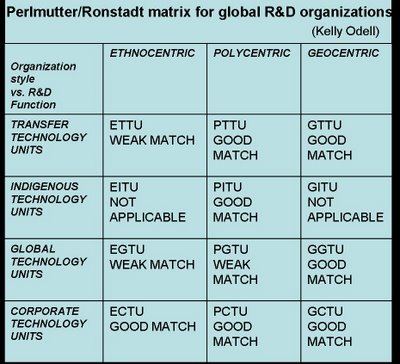
Ethnocentric Transfer Technology Units (ETTU)
ETTU's assume that the subsidiary does some manufacturing for the local market. In an ethnocentric company the transfer of technology from the parent to subsidiary is based on the transfer of a finished design to be implemented in local production. This design was originally created to meet the needs of the parent company's home market and is transferred to the subsidiary in an opportunistic fashion. A positive reaction to this product from the market might be considered "good luck" because no real consideration was taken to local market need by the parent company. These R&D units could be located anywhere in the world, however, their responsibility is limited to adaption of the design from headquarters to the local manufacturing facility.
Ethnocentric Indigenous Technology Units (EITU)
The indigenous technology unit cannot exist by definition in an ethnocentric corporation since the local subsidiary would not be allowed the freedom to develop and manufacture product specifically for the local market. This type of operation could represent a transitory position from ethnocentric to polycentric.
Ethnocentric Global Technology Units (EGTU)
In the strictest sense EGTU's cannot exist since in an ethnocentric organization a global technology unit is based at the headquarters and although simultaneous introduction of new technology may occur to capitalize on global scale, the product is primarily designed to meet the needs of the home market.
Ethnocentric Corporate Technology Units (ECTU)
Corporate Technology units are quite compatible with ethnocentric organizations. The ECTU is located in the headquarters and is focused on securing the long-term development of new technology or evaluating applicability of alternative technologies and processes for the parent corporation.
Polycentric Transfer Technology Units (PTTU)
If the polycentric corporation maintains transfer technology units, they will be located in the headquarters and used to transfer product designs or manufacturing technology to the subsidiary to then be adapted by the local organization. If a subsidiary were to develop a technology or design that is applicable to another market, the transfer would take place via the PTTU at the headquarters since there is no mechanism for communication between subsidiaries.
Polycentric Indigenous Technology Units (PITU)
The indigenous technology unit fits best in a polycentric organization. The freedom that the polycentric organization allows is an excellent environment for the development and manufacturing of products specifically for the local market.
Polycentric Global Technology Units (PGTU)
To operate global technology units in a polycentric organization would be very difficult since the various local organizations are accustomed to making adaptations to fit their local markets. If, for example, a PGTU, were to develop a product to be applied simultaneously around the world, the design would need to be so flexible as to allow for local adaption and additional time must be allocated, not only for product adaptation, but also for internally selling the concept to the relatively independent polycentric subsidiaries.
Polycentric Corporate Technology Units (PCTU)
Corporate technology units in polycentric companies operate as suppliers to the local subsidiaries. Probably located at the headquarters, the PCTU would "sell" to or take assignments from the local R&D units to evaluate new technologies or materials. The PCTU functions as an advanced research laboratory for a number of more application oriented units in the subsidiaries.
Geocentric Transfer Technology Units (GTTU)
The transfer technology unit is extremely important if the geocentric organization is going to function successfully. Transfer technology units can be located anywhere and have the responsibility for surveying best practices or new innovations throughout the company and implementing them or cross fertilizing wherever applicable. The GTTU can be either a formal organization or an informal function of all R&D units.
Geocentric Indigenous Technology Units (GITU)
Although indigenous technology units could exist in a geocentric corporation, it is contra the fundamental goal of that type of organization. In a properly functioning geocentric R&D unit, no new product would be developed in a subsidiary without striving to incorporate the needs of the global market. It could occur that a market segment were defined in a local market that was not evident in any other market and that this segment was deemed important enough to justify a specific product being developed. In this case the development might be executed in the local development organization or in some other subsidiary where a special competence was maintained, thus the concept represented by the GITU is not truly applicable.
Geocentric Global Technology Units (GGTU)
Global technology units capitalize on the open communication between subsidiaries around the world to maximize global scales in R&D, manufacturing, and marketing. Although global technology units can function well even in ethnocentric organizations the geocentric corporation's ability to leverage a global base of technical know-how and human resources gives a clear competitive advantage.
Geocentric Corporate Technology Units (GCTU)
In a geocentric organization, corporate technology can be located in a single unit anywhere in the world or it may be comprised of several different units carrying the responsibility for different areas of technology. The corporate technology function may also be divided between a number of R&D units with specific product responsibility (i.e. global technology units) which manage a segment of the corporate technology function based on their unique competencies. For example a global technology unit that is primarily focused on developing a product that requires special heat resistant plastics may also be responsible for the corporate technology unit for all heat resistant plastics for the entire company.
CONCLUSIONS
It should be noted that this Perlmutter/Ronstadt matrix would require more in depth analysis in order to confirm its viability as an evaluation tool. In this brief analysis some general conclusions can be drawn.
Ethnocentric
The first and maybe most obvious conclusion is that ethnocentric R&D organisations are not functional on a global scale. This does not mean that a company with ethnocentric R&D is not a global competitor. A company may be a global leader in their industry, however this would imply an industry in which the product is a relatively unimportant element of the marketing mix. This could be true of such products as Coca Cola or Chanel perfume. Another alternative is that the company has created a temporary monopoly for example with patents as in the case Astra and Losec.
Polycentric
As regards polycentric and geocentric organisations it could be concluded that both are equally functional for global R&D but the choice of organisation styles depends greatly on the nature of the industry.
Polycentric organisations are particularly applicable to industries in which there are large variations in the needs of the market. The food industry is a good example where companies like Unilever and Nestlé must develop products that meet the local tastes of consumers around the world.
The key to the polycentric R&D organisation is the indigenous technology unit which carries the responsibility for creating products that secure the company's success in the local market. The transfer technology units work to avoid simultaneous development of products in different markets and to cross-fertilize best practices or to transfer new knowledge from the corporate technology units.
The corporate technology units fill a secondary, but important role to the indigenous technology units. The corporate technology unit is not under the pressures of supplying the market with new products and can therfore fill the role of technology consultants looking ahead, evaluating and developing fundamental technology that will be fed to the more operative R&D units locally.
Geocentric
A geocentric organization is advantageous for industries in which market needs can be defined or segmented globally with little or no variations from country to country. In fast pace industries with short product lifecycles, a geocentric organisation for R&D gives the benefit of developing a large number of competitive products for immediate global introduction. The geocentric R&D organisation is a child of modern times, completely dependent on high speed telecommunication, jet travel and computers.
The driver in this type of organisation is the global technology unit. These units must be well coordinated to avoid overlapping, however, properly managed the geocentric global technology units operate as one R&D department with a number of complimentary projects being executed simultaneously. Although inconvenienced by geographical distance, the project teams are in constant communication. The corporate technology units in a geocentric organisation are crucial and although they can be located anywhere in the world they should be clearly separated from the global technology units. This will ensure that the corporate technology units are focused on long term technology development which will secure the future of the corporation.
Saturday, July 22, 2006
Lie Number Three: "Our product is at the end of its lifecycle!"
Every product will eventually reach the end of its lifecycle. Some marketers use end of lifecycle as an excuse for there own lack of ability to address challenges of a competitive environment. Most products are not at the end of their life but need repeated rejuvenation. These rejuvenations are not really new lifecycles just product updates. A product like a Ford has been developed, recreated and improved many times over the years but I would argue that the fundamental product lifecycle of the Ford is still alive and kicking.
When your product has reached the end of its lifecycle you will know it! No one will want to buy your product or the products of your competitors. It won’t be a question of how to upgrade the product but how to replace it. In Sweden there is a classic example of a product that reached the end of its lifecycle the classic case of FACIT. FACIT manufactured the “adding machines” and realized far too late that electronic calculators would turn adding machines into one of the dinosaurs of the office. The adding machine truly reached the end of its product lifecycle. Most of us work with products and services that are not at the end of their lifecycles. If you begin to think your product is, it is probably just time for the next version.
When your product has reached the end of its lifecycle you will know it! No one will want to buy your product or the products of your competitors. It won’t be a question of how to upgrade the product but how to replace it. In Sweden there is a classic example of a product that reached the end of its lifecycle the classic case of FACIT. FACIT manufactured the “adding machines” and realized far too late that electronic calculators would turn adding machines into one of the dinosaurs of the office. The adding machine truly reached the end of its product lifecycle. Most of us work with products and services that are not at the end of their lifecycles. If you begin to think your product is, it is probably just time for the next version.
Subscribe to:
Posts (Atom)
